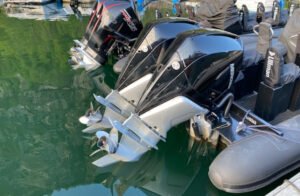


Outboard weight is a fundamental specification that should be considered alongside horsepower, shaft length, and installation requirements. The engine is mounted at the stern, so its mass directly affects the boat’s weight distribution, transom loading, trim, acceleration, planing behaviour, and handling. Two engines with similar horsepower can have meaningfully different weights and dimensions. Current manufacturer specifications demonstrate this clearly: Honda’s BF200/BF225/BF250, for example, are listed at approximately 275–286 kg depending on shaft and control configuration, while Honda’s BF115/BF140/BF150 range is approximately 218–224 kg.
Weight also becomes particularly important when repowering an existing vessel. The fact that a replacement engine has the same horsepower as the original does not automatically make it a suitable replacement. The transom must be capable of supporting the engine, and the resulting weight distribution must remain appropriate for the hull. Tohatsu’s technical documentation lists different masses according to shaft configuration, while Suzuki publishes model-specific weights and transom heights, reinforcing the importance of evaluating the exact engine configuration rather than relying on horsepower alone.
Horsepower Does Not Tell You Engine Weight
There is no universal relationship between horsepower and weight. Engine architecture, displacement, number of cylinders, gearcase design, shaft length, controls, and equipment can all change the final mass. Even different configurations of the same engine may have different published weights.
For example, Honda lists the BF200, BF225, and BF250 at 275–278 kg in L-type mechanical configurations and up to 285–286 kg in X-type iST configurations. Suzuki’s DF150SS is listed at 511 lb for the 20-inch configuration and 522 lb for the 25-inch version, while its DF250SS ranges from 578 to 606 lb. These differences demonstrate why the exact model, shaft length, and equipment specification should always be checked before installation.
Why Stern Weight Matters
Adding substantial weight at the stern changes the boat’s longitudinal weight distribution. Depending on hull design, additional stern mass can increase stern immersion and alter the vessel’s running attitude. This can affect how quickly the boat transitions onto plane and how the hull behaves once underway.
The effect is particularly relevant on smaller or lighter boats where an outboard represents a significant percentage of total vessel weight. A relatively modest difference in engine mass can have a much greater practical effect on a lightweight hull than on a large offshore vessel designed around substantial propulsion equipment.
Weight and Planing Performance
A planing boat must generate sufficient hydrodynamic lift to overcome its displacement and transition efficiently onto plane. Additional stern weight can influence that transition by increasing the load the hull must lift and changing its trim attitude.
This does not mean that a heavier engine will automatically make a boat perform poorly. Hull design, available horsepower, propeller selection, trim, and weight distribution all interact. Honda’s published performance data illustrates how the same engine can be paired with different boats and propeller specifications, producing different performance characteristics depending on the complete combination.
The important point is that engine weight should be assessed as part of the entire boat-and-propulsion package, not in isolation.
Weight and Transom Capacity
The transom carries the engine’s static weight as well as the dynamic loads generated while the vessel is underway. A boat designed for a particular engine class has structural and capacity limitations that should be respected during installation or repowering.
The manufacturer’s boat specifications and capacity plate should therefore be checked before installing a heavier outboard. If a replacement engine is significantly heavier than the original, a qualified marine professional should determine whether the existing transom, mounting arrangement, steering system, and associated hardware are suitable for the new installation.
Shaft Length Can Change Engine Weight
A longer-shaft configuration can weigh more than the corresponding shorter-shaft version because of differences in the physical configuration of the engine and mounting assembly. Suzuki’s official specifications provide a clear example: its DF150SS is listed at 511 lb in the 20-inch configuration and 522 lb in the 25-inch configuration.
Tohatsu similarly publishes separate weights for different shaft configurations. Its BFT150D documentation lists 487 lb for the 20-inch version, 494 lb for the 25-inch version, and 500 lb for the 25-inch XCR configuration. Consequently, buyers should always compare the weight of the exact shaft and equipment configuration they intend to purchase.
Engine Weight and Repowering
Repowering is where engine weight becomes particularly important. A new engine may match the original horsepower while being substantially heavier due to different engine architecture or equipment. Installing it without assessing the consequences can change the boat’s static trim and dynamic handling.
The repower assessment should include the original engine’s weight, replacement engine weight, shaft length, mounting position, steering and control arrangement, battery location, fuel system, and other equipment that may change the vessel’s final weight distribution. The replacement should be evaluated as a complete installation rather than as an engine-only purchase.
Weight and Boat Balance
Boat balance depends on the distribution of mass throughout the vessel. Moving significant weight toward the stern can change how the boat sits at rest and how it behaves when accelerating. Passenger positioning, fuel tanks, batteries, livewells, fishing equipment, and other onboard systems can compound the effect of a heavier outboard.
This is why engine weight should be considered together with the normal operating load. A boat that carries substantial equipment at the stern may respond differently to a heavier engine than the same hull operated with a lighter load. The objective is to maintain a balanced configuration appropriate to the hull’s design.
Weight and Fuel Efficiency
Engine weight can influence fuel efficiency indirectly through the additional displacement the boat must move. More weight can increase the power required to accelerate and maintain certain operating conditions, although the actual effect depends heavily on hull design and speed.
A heavier engine can also deliver advantages that offset some of its additional mass. A newer engine may provide improved combustion efficiency, better control systems, or a more appropriate power curve than the engine it replaces. Consequently, weight should never be evaluated independently from fuel consumption, performance, and engine technology.
Lightweight Does Not Automatically Mean Better
The lightest available outboard is not automatically the best choice. Reducing engine mass can be advantageous, particularly on smaller vessels, but the engine still needs to provide adequate power, durability, charging capacity, controls, shaft configuration, and other required characteristics.
The correct selection is therefore the lightest engine that properly satisfies the boat’s technical and operational requirements, rather than simply choosing the lowest published weight. A lighter engine that is poorly matched to the vessel can produce a worse overall result than a heavier engine correctly designed for the application.
Weight and Multiple Outboard Installations
Twin and multiple-engine configurations make weight management even more important because the combined engine mass can be substantial. Engine spacing, transom structure, steering, controls, battery placement, and fuel-system configuration all contribute to the final installation.
High-output engines can also vary considerably in weight. Suzuki’s published DF250A Stealth specification, for example, lists 624 lb for the 20-inch version and 637 lb for the 25-inch configuration. When multiple engines are installed, these differences are multiplied across the propulsion system and should be incorporated into the vessel’s engineering and loading assessment.
Published Weight Is Not Always the Same as Installed Weight
Manufacturer specifications often identify a particular definition of engine weight. Suzuki, for example, states that its published dry weight includes the battery cable but excludes the propeller and engine oil. Tohatsu’s documentation similarly specifies the conditions under which its published mass is measured.
This distinction matters when estimating the actual installed weight. Propeller, lubricants, rigging, steering components, batteries, controls, and other installation equipment can add mass beyond the published engine figure. For repowering calculations, these additional components should be considered rather than treating the brochure weight as the complete installed propulsion weight.
How to Compare Outboard Weight Correctly
When comparing engines, use the manufacturer’s published specifications for the exact model, shaft length, starting system, controls, and other relevant configuration. Compare weight alongside horsepower, displacement, gear ratio, transom requirements, and installation dimensions.
For example, Honda publishes separate weights for its mechanical and iST configurations, while Suzuki differentiates weight by shaft length. These differences can be significant enough to influence the final installation decision, particularly on smaller vessels or repower projects.
The Right Weight for the Right Boat
Outboard weight is ultimately a compatibility specification, not merely a number used for comparison. The appropriate engine must remain within the boat’s structural and operational limits while providing the required power and maintaining suitable weight distribution.
Before purchasing or repowering, confirm the boat manufacturer’s maximum engine specifications, transom requirements, replacement engine weight, shaft length, mounting configuration, and associated equipment. When the replacement is substantially heavier than the original engine, professional assessment is appropriate. Proper weight matching protects transom integrity, preserves handling characteristics, and gives the propulsion system the best opportunity to perform as designed.