
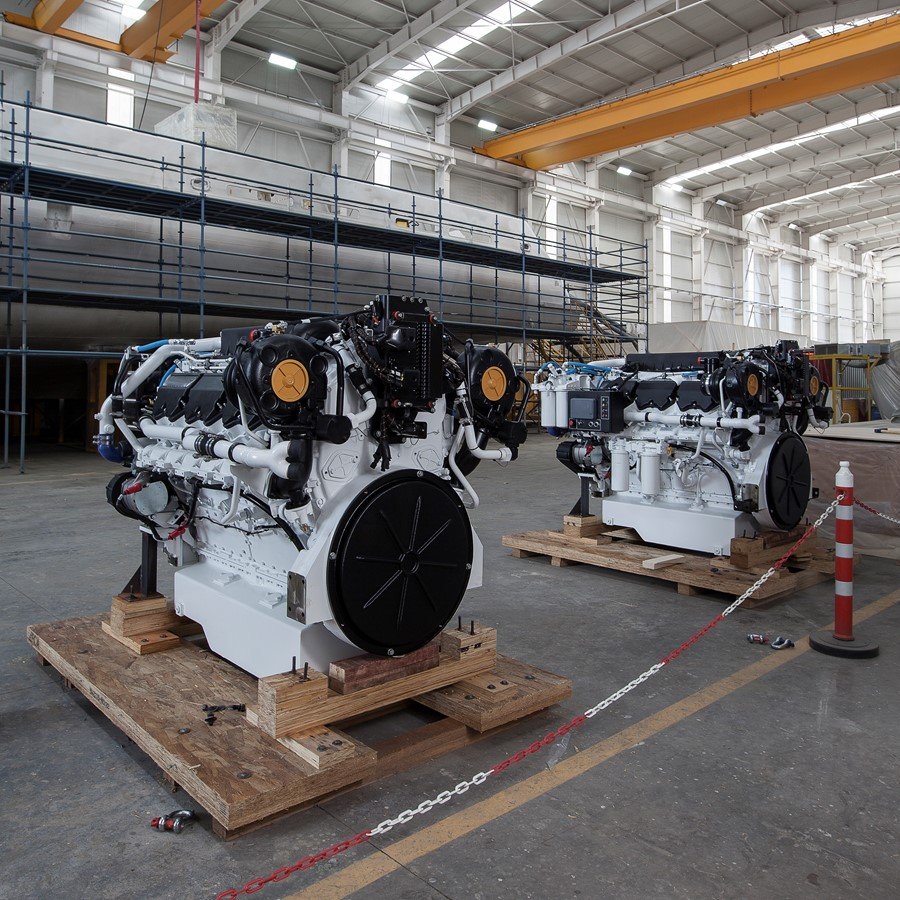
There is no single marine diesel engine brand that is objectively the best for every vessel. Yanmar, Volvo Penta, Cummins, Caterpillar, MAN and mtu occupy different positions across recreational boating, yachts, fishing vessels, workboats, patrol craft, commercial vessels and high performance marine applications. The meaningful comparison is therefore not simply brand against brand, but which manufacturer’s engine architecture, power range, duty rating, installation requirements and support structure best match the vessel’s mission. Their current official portfolios demonstrate substantial differences: Yanmar covers engines from 10 to 640 MHP in its principal marine range, Volvo Penta’s inboard shaft range currently spans 12.2 to 1,000 hp, Cummins extends from smaller marine propulsion engines to the 4,200 hp QSK95, while Caterpillar, MAN and mtu extend into substantially larger commercial and high-performance propulsion systems.
A serious buyer should therefore evaluate power, torque, displacement, rated RPM, duty cycle, fuel consumption, engine dimensions and weight, emissions configuration, gearbox compatibility, installation requirements, service network and lifecycle cost. A 300 hp engine intended for recreational cruising is not directly equivalent to a 300 hp engine designed around demanding commercial operation simply because their peak ratings are similar. MAN, for example, explicitly separates light, medium and heavy duty marine operation by annual operating hours and load share, while Cummins publishes distinct continuous, heavy-duty, medium-continuous and intermittent rating definitions.
Yanmar Marine Engines
Yanmar has a particularly broad presence across smaller craft, sailing yachts, powerboats, light-duty commercial vessels and larger commercial marine applications. Its current marine diesel range runs from the 10 MHP GM engine through common-rail models including the 4LV, 8LV, 6LY, 6LF and 6LT, with the listed recreational/light-duty range extending to 640 MHP. Yanmar also operates a separate commercial marine portfolio containing high-speed and medium-speed propulsion engines, auxiliary engines and alternative-fuel technologies.
One of Yanmar’s defining technical characteristics is its extensive use of common-rail technology. The company states that its common-rail marine engines span 40–640 MHP and use electronically controlled high-pressure fuel injection, multiple sensors and an ECU to regulate injection timing and quantity. Yanmar also emphasizes global service and parts support, stating that its network covers 130 countries and more than 2,100 locations. That combination makes Yanmar particularly relevant when compact dimensions, efficient propulsion, recreational usability, light commercial operation and established marine support are important selection criteria.
Volvo Penta Marine Engines
Volvo Penta has a strong position in both recreational and commercial marine propulsion, with its inboard shaft diesel range currently including the D1, D2, D4, D6, D8, D11, D13 and D16 MH. The published inboard shaft range extends from 12.2 hp on the D1 through 1,000 hp on the D13, while the larger D16 MH reaches 850 hp in its stated configuration. The range is therefore broad enough to address everything from smaller inboard installations to demanding commercial propulsion.
Volvo Penta’s differentiation is particularly strong around integrated propulsion and vessel control. Its commercial inboard shaft systems are presented around marine torque, acceleration, sustained cruising performance and integration with monitoring systems. Its range also includes multiple propulsion architectures rather than limiting the company to conventional shaft drive. For buyers who place a high value on integrated controls, propulsion-system engineering, recreational usability and commercial marine technology, Volvo Penta can be a particularly compelling option.
Cummins Marine Engines
Cummins has one of the broadest power portfolios in this comparison. Its current marine propulsion lineup includes engines such as the QSB6.7/QSB7, QSC8.3, QSL9, QSM11, X15, QSK19, QSK38, QSK50, QSK60 and QSK95. Published marine outputs range from 230 hp on the QSB6.7/QSB7 family to 4,200 hp on the QSK95, giving Cummins a substantial presence from smaller recreational and commercial craft through very high-output marine applications.
Cummins also places significant emphasis on application-specific ratings. Its published rating definitions distinguish continuous duty, heavy duty, medium continuous and intermittent operation according to load factor and allowable full-power operation. That makes duty-cycle analysis particularly important when comparing a Cummins engine with another manufacturer’s model. Cummins also states that its marine solutions cover commercial, government and recreational applications, meaning the brand can be evaluated across a very wide range of vessel missions rather than being associated with one particular boat category.
Caterpillar Marine Engines
Caterpillar’s marine propulsion portfolio is particularly strong in commercial and high-output applications. Its current commercial propulsion lineup includes the C7.1, C9.3, C12, C18, C32, C32B, 3512, 3516 and C280 families, alongside high-performance propulsion engines and integrated marine power solutions. Cat also positions its marine offering around commercial vessels such as tugs and offshore craft, as well as yachting, sportfishing and government and defense applications.
One important characteristic of Caterpillar’s offering is the combination of propulsion hardware with controls, electronics, generator sets, auxiliary power and lifecycle support. Its C18, for example, is offered for applications ranging from fishing to offshore operations, while the C32 is available in configurations addressing multiple emissions standards and is supported through Cat’s global dealer network. Caterpillar’s broader marine strategy therefore makes the brand particularly relevant when an operator wants propulsion and vessel-power infrastructure supported through a large industrial service ecosystem.
MAN Marine Engines
MAN occupies a particularly important position in higher-output commercial marine propulsion. Its current commercial portfolio includes the six-cylinder D2676, V8 D2868 and V12 D2862, with outputs varying according to duty rating. MAN explicitly classifies these engines according to light, medium and heavy-duty operation, with examples ranging from patrol and escort vessels to passenger ships, ferries, fishing vessels, tugs, trawlers and other working vessels.
The duty-rating structure is one of the most useful ways to understand MAN’s commercial offering. MAN defines light-duty operation at up to 1,000 annual hours, medium-duty operation at up to 3,000 hours and heavy-duty operation without an annual operating-hour limit, with different permitted full-load shares for each category. Its D2862, for example, is a 24.2-litre V12 available across multiple duty ratings and outputs. This makes MAN particularly relevant when the buyer needs to evaluate an engine around actual commercial workload rather than peak horsepower alone.
mtu Marine Engines
mtu operates at the high-performance end of marine propulsion, with its current portfolio including Series 2000, Series 4000, Series 1163 and Series 8000 engines. The published power ranges demonstrate the scale: Series 4000 spans 746–4,300 kW, Series 1163 spans 4,800–7,400 kW and Series 8000 spans 7,280–10,000 kW. These engines address applications including high-performance yachts, patrol vessels, fast ferries, displacement yachts and other demanding marine platforms.
The mtu proposition is consequently very different from that of a manufacturer primarily focused on small recreational engines. High power density, high-speed propulsion and demanding operational requirements are central to the portfolio, with Series 1163 specifically positioned for fast vessels with intermittent load factors. mtu also supplies integrated commercial marine solutions around engines, propulsion systems and onboard power. For large, fast or highly demanding vessels, mtu belongs in a different performance category from compact marine-engine ranges.
Which Brand Has the Widest Power Range?
The answer depends on which part of each manufacturer’s current marine portfolio is being compared. Cummins publishes marine propulsion ratings from approximately 230 hp to 4,200 hp in its current lineup, while mtu’s published marine engine portfolio reaches approximately 13,410 bhp with the Series 8000. Caterpillar also extends from relatively modest commercial propulsion engines to the C280 families, while MAN’s current commercial high-speed portfolio reaches 2,000 hp on the D2862.
Yanmar and Volvo Penta are particularly strong across the lower and middle portions of the marine propulsion market, although both also have higher-output commercial offerings beyond their mainstream recreational ranges. Yanmar’s principal marine range reaches 640 MHP, while Volvo Penta’s current inboard shaft range reaches 1,000 hp. The important point is that power range alone does not determine which manufacturer is better; it simply establishes which engines are candidates for a particular vessel.
Which Brand Is Best for Recreational Boats?
For recreational applications, Yanmar and Volvo Penta have particularly broad and clearly defined offerings. Yanmar’s lineup includes compact sailboat and small-craft engines as well as powerboat engines, while Volvo Penta offers inboard shaft engines across a broad recreational range and additional integrated propulsion technologies.
Cummins also has a significant recreational marine presence, particularly in higher-output applications, while Caterpillar and MAN can become relevant as vessel size, power requirements and operating demands increase. The right choice should be made from the boat builder’s approved engine options and the vessel’s intended use rather than from brand reputation alone.
Which Brands Are Strong for Commercial Vessels?
Commercial marine propulsion changes the selection criteria substantially. Long operating hours, high load factors, fuel consumption, serviceability, parts availability, redundancy and downtime become much more important than they may be on a privately used recreational boat.
All six manufacturers have commercial marine offerings, but their portfolios emphasize different segments. Yanmar has dedicated commercial high-speed and medium-speed propulsion products; Volvo Penta offers commercial inboard shaft diesels; Cummins spans commercial and government applications into very high power; Caterpillar has extensive commercial propulsion and integrated marine power systems; MAN explicitly structures engines around commercial duty ratings; and mtu specializes heavily in high-performance and demanding commercial marine propulsion.
Which Is Best for Heavy-Duty Operation?
For heavy-duty applications, duty rating matters more than brand prestige. An engine intended for unlimited annual operating hours at high load should not be compared with an engine designed around intermittent recreational use simply because both produce similar peak horsepower.
MAN provides an unusually clear example of this principle, explicitly defining heavy-duty operation as unlimited annual operating hours with up to 100% full-load share on its listed commercial engines. Cummins similarly defines continuous-duty ratings according to high load factors. These published classifications are valuable because they allow buyers to evaluate an engine against the vessel’s actual workload.
Technology and Electronic Control
All six manufacturers use modern engine-management technologies, although implementation varies by model. Yanmar’s common-rail system uses high-pressure fuel injection, multiple sensors and ECU control; Caterpillar’s C7.1 uses a common-rail fuel system and electronic control; MAN’s D2862 uses common-rail injection with EDC control; and mtu’s modern marine engines incorporate advanced electronic management and turbocharging technologies.
This means a buyer should not simply ask which brand has “the best technology.” A more useful question is which technology package is appropriate for the vessel, emissions requirements, control architecture, service capability and operating environment.
Service and Parts Support
For a marine engine, service support is part of the product. An engine that performs exceptionally well but cannot be serviced efficiently in the vessel’s operating region can create significant downtime and operating costs.
Yanmar states that its global marine support network covers 130 countries and more than 2,100 locations. Cummins has historically emphasized its global distributor and service network, while Caterpillar operates through its extensive dealer infrastructure. The availability of qualified technicians and genuine parts should nevertheless be verified for the specific country and engine model before purchase rather than assuming that a global brand automatically means local support.
So, Which Marine Diesel Brand Is Best?
The strongest answer is application-specific:
Application Brands Worth Closely Considering
Small craft and sailing vessels Yanmar, Volvo Penta
Recreational powerboats Yanmar, Volvo Penta, Cummins
Larger yachts Volvo Penta, Cummins, Caterpillar, MAN, mtu
Fishing and workboats Yanmar, Cummins, Caterpillar, MAN
Commercial high-hour vessels Cummins, Caterpillar, MAN, mtu, Yanmar Commercial
High-performance vessels mtu, MAN, Caterpillar, Cummins
Very high-output propulsion Cummins, Caterpillar, MAN, mtu
Integrated vessel power solutions Caterpillar, Cummins, Volvo Penta, mtu
This table should be interpreted as a starting point for evaluation, not a universal ranking. The actual engine must still be matched to horsepower, displacement, duty rating, vessel design, propulsion arrangement and regulatory requirements.
Final Verdict
Yanmar stands out for its broad compact-to-midrange marine coverage and strong common-rail technology and service infrastructure. Volvo Penta is particularly strong where integrated recreational and commercial propulsion systems, controls and marine torque are important. Cummins offers an exceptionally broad power range and strong coverage across recreational, commercial and government applications. Caterpillar brings a large industrial ecosystem and extensive commercial propulsion and vessel-power capability. MAN is particularly compelling for high-output commercial propulsion where clearly defined duty ratings are critical. mtu occupies the high-performance end of the spectrum, with extremely high-output engines for demanding vessels.
The best marine diesel engine is therefore not the brand with the biggest horsepower figure or the strongest marketing reputation. It is the engine that provides the correct power and torque at the required RPM, survives the vessel’s duty cycle, fits the installation, meets applicable emissions requirements, integrates correctly with the gearbox and propeller, and can be supported throughout its operating life. That is the standard a professional marine-engine buyer should use when comparing Yanmar, Volvo Penta, Cummins, Caterpillar, MAN and mtu.