

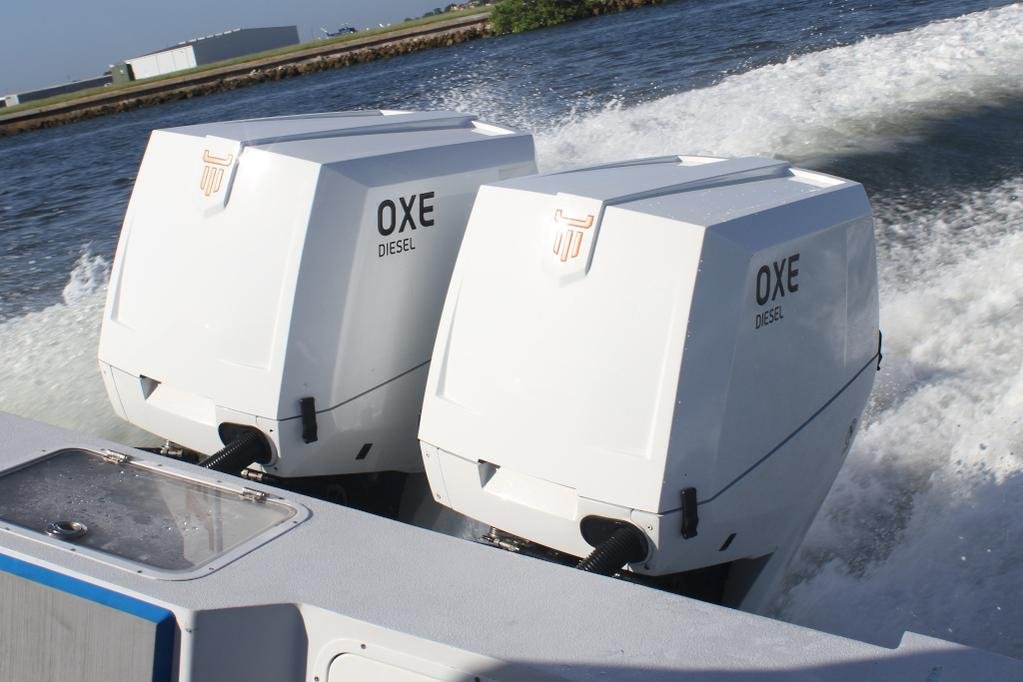
Petrol and diesel outboard motors use fundamentally different combustion systems and are suited to different operating requirements. Petrol outboards dominate recreational marine propulsion because of their broad availability, relatively low weight, established technology, and wide range of horsepower options. Mercury’s current FourStroke range, for example, extends from portable 2.5 hp engines through 300 hp models. Diesel outboards occupy a more specialised position, particularly where fuel economy, high torque, extended range, fuel commonality, and commercial-duty operation are important. OXE Marine’s current diesel range includes the OXE150, OXE175, OXE200, OXE225, OXE250 and OXE300, while Cox Marine’s CXO300 is a purpose-built 300 hp diesel outboard.
The right choice is therefore not simply about whether petrol or diesel is the “better” fuel. It depends on the vessel, annual operating hours, load, range requirements, fuel availability, installation weight, acquisition cost, and intended mission. Diesel can offer substantial advantages in high-hour commercial applications, but a petrol outboard can remain the more appropriate solution for many recreational boats where low weight, simplicity, initial cost, and broad model availability are priorities.
Fuel Type and Combustion
Petrol and diesel engines use different methods of igniting the fuel-air mixture. Petrol engines generally use spark ignition, while diesel engines use compression ignition. The different combustion principles influence the engines’ torque characteristics, operating speeds, fuel systems, and overall architecture.
Diesel outboards such as the OXE300 use a turbocharged, intercooled inline-six diesel architecture, with the current OXE300 specification listing 300 hp and up to 945 Nm of torque depending on the version. Cox’s CXO300 uses a 4.4-litre twin-turbo V8 diesel with high-pressure common-rail fuel injection and 650 Nm of peak torque. These are specialised marine diesel powerplants rather than simply petrol outboards converted to another fuel.
Fuel Economy
Fuel consumption is one of the principal reasons diesel propulsion is attractive for high-hour marine operations. OXE reports that its diesel outboards can use significantly less fuel than comparable leisure gasoline outboards and currently cites up to 40% lower fuel consumption in its performance information. Cox’s published CXO300 comparison recorded 72 L/h for its diesel outboard against 98 L/h for a 300 hp gasoline outboard and 140 L/h for a 400 hp gasoline outboard under the stated sea-trial conditions.
These figures should not be interpreted as universal petrol-versus-diesel consumption percentages. Fuel burn changes with hull design, engine loading, propeller selection, speed, sea conditions, and installation. The meaningful comparison for an operator is fuel consumed under the same vessel, load, speed, and operating conditions.
Torque and Heavy Loads
Diesel engines are particularly attractive where substantial low- and mid-range torque is valuable. High torque can assist vessels that regularly carry heavy loads, operate commercially, tow equipment, or require strong acceleration and thrust under demanding conditions.
OXE’s current OXE300 specification lists 945 Nm of peak torque at 2,250 rpm, while the OXE250 and OXE225 are listed at 790 Nm and 700 Nm respectively. Cox’s CXO300 produces 650 Nm of peak torque and uses a twin-turbocharged V8 architecture. This torque characteristic is one reason high-powered diesel outboards have found a niche in commercial and demanding marine applications.
Weight
Weight is one of the areas where petrol outboards often have a practical advantage, particularly at smaller and medium horsepower levels. Diesel engines typically require heavier-duty components and fuel-system architecture, and specialised high-powered diesel outboards can therefore be considerably heavier than comparable petrol engines.
The current OXE300, for example, is listed at approximately 430 kg / 948 lb in its current specification, while the Cox CXO300 is listed at 393 kg / 866 lb in its technical specification. That additional mass must be considered when evaluating transom capacity, boat balance, planing performance, and repowering compatibility.
Fuel Handling and Storage
Diesel has a higher flash point than petrol, making its vapour behaviour and handling characteristics different from those of gasoline. OXE specifically highlights diesel’s higher flash point as an advantage for fuel storage and handling and notes that its engines can use the same diesel fuel carried by a vessel’s main propulsion system.
This can be particularly valuable for commercial operators using diesel throughout a vessel or fleet. It can simplify fuel logistics by reducing the need to maintain separate petrol and diesel supplies. However, diesel fuel still requires proper storage, filtration, contamination control, and handling procedures.
Range and Long-Distance Operation
Fuel economy can translate directly into increased range when tank capacity remains unchanged. OXE states that its diesel propulsion can provide increased operational range compared with equivalent gasoline propulsion and specifically markets its technology toward operators who prioritise range, uptime, and fuel consumption.
For offshore, patrol, commercial fishing, transport, and other high-hour operations, the ability to travel farther on a given fuel load can have significant operational value. The actual range of any boat, however, must be calculated from its real fuel capacity, fuel consumption, cruising speed, reserve requirement, hull characteristics, and operating conditions.
Maintenance and Service Requirements
Petrol and diesel engines both require structured preventive maintenance. Oil, filters, cooling systems, fuel systems, gearcases, anodes, propellers, and other components must be serviced according to the manufacturer’s schedule.
Diesel outboards should not be assumed to require less maintenance simply because diesel engines are traditionally associated with durability. OXE specifically instructs owners to follow its user manual and service schedule and to use OXE-recommended oils, coolant, and genuine spare parts. Cox likewise designed the CXO300 around commercial and recreational applications with defined service requirements and warranty conditions.
Durability and High-Hour Applications
Diesel engines are commonly selected for applications where substantial annual operating hours make fuel consumption, durability, and downtime particularly important. Cox describes the CXO300 as purpose-built for commercial and recreational marine applications, while OXE positions its diesel outboards for demanding users and commercial operations.
This does not mean every diesel outboard will automatically outlast every petrol outboard. Service life depends on engine design, operating load, maintenance, corrosion exposure, service quality, and operating conditions. Claims about longevity should therefore be evaluated against the specific manufacturer’s published service information rather than treated as a universal petrol-versus-diesel rule.
Initial Cost and Total Cost of Ownership
A petrol outboard may be financially attractive where annual operating hours are relatively low because the initial acquisition and installation cost can be lower for an equivalent recreational application. Diesel propulsion can become increasingly attractive as annual operating hours and fuel consumption increase.
Cox’s own published comparison specifically frames the CXO300 around reduced fuel consumption and total cost of ownership for appropriate commercial applications. The correct financial comparison should therefore include purchase price, installation, fuel consumption, annual operating hours, maintenance, downtime, fuel availability, and expected service requirements, rather than comparing engine prices alone.
Recreational vs Commercial Use
Petrol outboards remain exceptionally versatile for recreational boating. Their extensive horsepower range and widespread availability make them suitable for fishing boats, family boats, tenders, watersports vessels, and many other applications. Mercury’s current FourStroke range illustrates the breadth of petrol outboard applications available to recreational users.
Diesel outboards become particularly compelling when the mission involves sustained operation, heavy loads, long range, commercial duty, or a vessel already standardised around diesel fuel. OXE explicitly markets its engines for demanding applications ranging from commercial workboats to offshore operations, while Cox has documented CXO300 installations in professional RIB and port operations.
Petrol or Diesel: Which Should You Choose?
Petrol is generally the logical choice when low weight, broad model availability, recreational use, straightforward installation, and lower initial acquisition cost are important.
Diesel becomes particularly compelling when high annual engine hours, fuel economy, heavy-duty operation, long range, high torque, fuel commonality, and reduced operational fuel consumption are priorities.
Neither fuel type is universally superior. The correct propulsion system is the one that matches the boat’s structure, operating profile, required horsepower, annual hours, fuel infrastructure, and economic objectives. For a recreational boat used occasionally, the simplicity and broad availability of petrol propulsion can outweigh diesel’s fuel-efficiency advantages. For a commercial vessel operating hundreds or thousands of hours annually, diesel’s efficiency and torque can materially change operating economics.
The Practical Difference
The most important distinction is how the engine will be used. Petrol outboards provide a mature, highly versatile propulsion solution across a very broad recreational market. Diesel outboards provide a specialised alternative where operating efficiency, torque, range, fuel handling, and high-hour utilisation justify their additional weight and complexity.
OXE and Cox demonstrate that modern diesel outboards are no longer limited to conventional low-speed commercial applications. Their current products deliver substantial horsepower in outboard configurations, with OXE offering diesel engines from 150 hp through 300 hp and Cox producing the 300 hp CXO300. The final decision should therefore be based on the mission and complete propulsion system, not on fuel type alone.