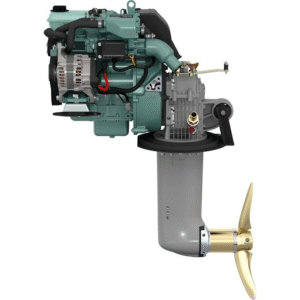
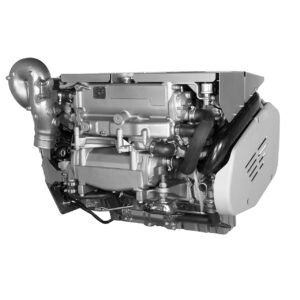
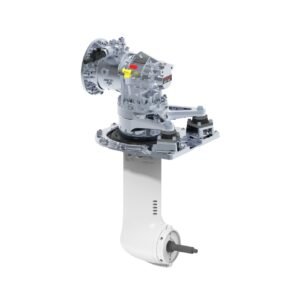
A V drive installation is defined by the relationship between the engine, transmission and propeller shaft rather than by horsepower alone. The engine is positioned forward while the transmission redirects the power aft toward the propeller shaft, creating a propulsion arrangement that can make more effective use of the vessel’s internal space and influence weight distribution. This configuration has long been used in cruisers, yachts, sport boats and other inboard powered vessels where engine placement and shaft geometry are important parts of the hull design. We source engines and compatible V drive propulsion solutions for customers undertaking new installations, replacement projects and repowers, working from the vessel’s existing drivetrain, required output, engine dimensions and transmission specification to identify an appropriate solution.
Yanmar V Drive Engines
Yanmar’s marine diesel portfolio includes engine platforms that can be paired with marine transmissions suitable for V drive installations. Its compact and mid-range diesel architecture is particularly relevant to recreational vessels where machinery placement, available engine-room space and efficient propulsion need to be balanced carefully. The 4LV, 6LY, 6LF, 6LT and 8LV families cover substantially different power requirements, giving boat owners and builders several routes into diesel V drive propulsion. Exact gearbox selection remains dependent on the engine output, reduction requirement and vessel’s shaft arrangement.
Yanmar V drive engine options:
4LV Series
* 4LV150
* 4LV170
* 4LV195
* 4LV230
* 4LV250
6LY Series
* 6LY400
* 6LY440
6LF Series
* 6LF485
* 6LF530
* 6LF550
6LT Series
* 6LT500
* 6LT580
* 6LT640
8LV Series
* 8LV320
* 8LV350
* 8LV370
Yanmar’s marine transmission range includes V drive configurations for applicable engine applications, making the complete engine and gearbox combination an important part of the sourcing specification.
Volvo Penta V Drive Engines
Volvo Penta has extensive experience with inboard propulsion systems where engine, transmission and shaft geometry must work as a single installation. Its diesel platforms cover recreational boats through larger vessels, while Volvo Penta’s electronically integrated marine systems provide additional flexibility when the propulsion package is being incorporated into a modern vessel architecture. For an existing V drive boat, the original transmission and shaft arrangement are particularly valuable reference points when determining the replacement engine.
Volvo Penta V drive engine options:
D4 Series
* D4-230
* D4-270
* D4-300
* D4-320
D6 Series
* D6-300
* D6-340
* D6-380
* D6-440
* D6-480
D8 Series
* D8-450
* D8-550
* D8-600
D11 Series
* D11-510
* D11-625
* D11-670
* D11-725
The correct Volvo Penta V drive configuration depends on the specific transmission, shaft angle, reduction ratio and installation arrangement. Those details should be confirmed against the vessel’s original engineering specifications before selecting a replacement.
Cummins V Drive Boat Engines
Cummins marine diesel propulsion is used across yachts, fishing vessels and commercial craft, with its engine architecture providing substantial torque for vessels using conventional shaft propulsion. V drive installations can be particularly useful on cruising boats where the location of the machinery space needs to be coordinated with accommodation, shaft alignment and hull geometry. The engine therefore needs to be considered together with its marine gear rather than purchased solely on the basis of horsepower.
Cummins V drive engine options:
QSB Series
* QSB6.7
* QSB7
QSC Series
* QSC8.3
QSL Series
* QSL9
QSM Series
* QSM11
X Series
* X15
These platforms cover considerably different vessel sizes and duty requirements. For a replacement project, the existing Cummins model, transmission identification plate, shaft arrangement and vessel specifications can provide the information necessary to determine a compatible propulsion package.
V Drive Propulsion for Yachts and Cruisers
The appeal of V drive propulsion is closely connected to vessel architecture. By placing the engine farther forward and redirecting the drivetrain toward the stern, designers can arrange machinery and accommodation differently from a conventional straight shaft installation. This can be valuable on certain yachts and cruisers where available engine-room volume, center-of-gravity considerations and interior layout must be balanced against propulsion requirements. The arrangement can also influence the location of the propeller shaft, rudder and underwater running gear, meaning the drivetrain is an integral part of the boat’s original engineering.
For a repower, the existing installation becomes the starting point. Engine length and height, mounting locations, transmission dimensions, output flange, reduction ratio, shaft angle and propeller characteristics all need to correspond with the replacement system. A motor that produces the required horsepower is not necessarily a suitable V drive replacement if its physical or drivetrain characteristics differ substantially from the original installation. We therefore work from the complete available specification when helping customers source a replacement.
V Drive Engine and Transmission Compatibility
A V drive engine should be evaluated as part of a complete propulsion package. The engine produces the power, but the transmission determines how that power is transferred into the shaft system, while the propeller converts the available torque into thrust. Reduction ratio, shaft diameter, shaft angle, propeller clearance and engine operating speed all affect the final result. This is particularly important when upgrading horsepower because increasing engine output without appropriately reviewing the transmission, shafting and propeller can create an improperly matched propulsion system.
Customers planning a V drive repower can provide the boat make and model, year, existing engine, transmission model, horsepower, number of engines and shaft configuration. Photographs of the existing engine and transmission identification plates can also be useful when establishing the specification. From there, we can work toward an appropriate engine and compatible propulsion arrangement instead of treating the project as a simple engine replacement.
V Drive Boat Engine Applications
V drive systems are found across a range of vessels where the propulsion architecture provides a practical solution to machinery placement. Recreational cruisers can use the arrangement to manage interior space, while yachts may incorporate it into a larger integrated propulsion design. Certain sport and performance boats also use V drive configurations where the drivetrain arrangement forms part of the vessel’s handling and layout strategy. The appropriate application ultimately depends on the boatbuilder’s design and the engineering characteristics of the hull.
For customers sourcing a replacement or new engine, the objective is to preserve the intended relationship between the power unit and the rest of the propulsion system. That means considering the engine, gearbox, mounts, shafting, exhaust, cooling, controls and electrical connections together. Where the original configuration is no longer available, we can also help investigate alternative manufacturers and current-production options that may satisfy the vessel’s requirements.
Source Your V Drive Boat Engine
Whether you are replacing an existing V drive diesel, upgrading an older propulsion system or sourcing engines for a new vessel, we can help identify suitable options from leading marine manufacturers.
Send us your boat specifications, existing engine and transmission details, required horsepower or preferred manufacturer, and our team can assist with V drive engine sourcing and purchasing.