
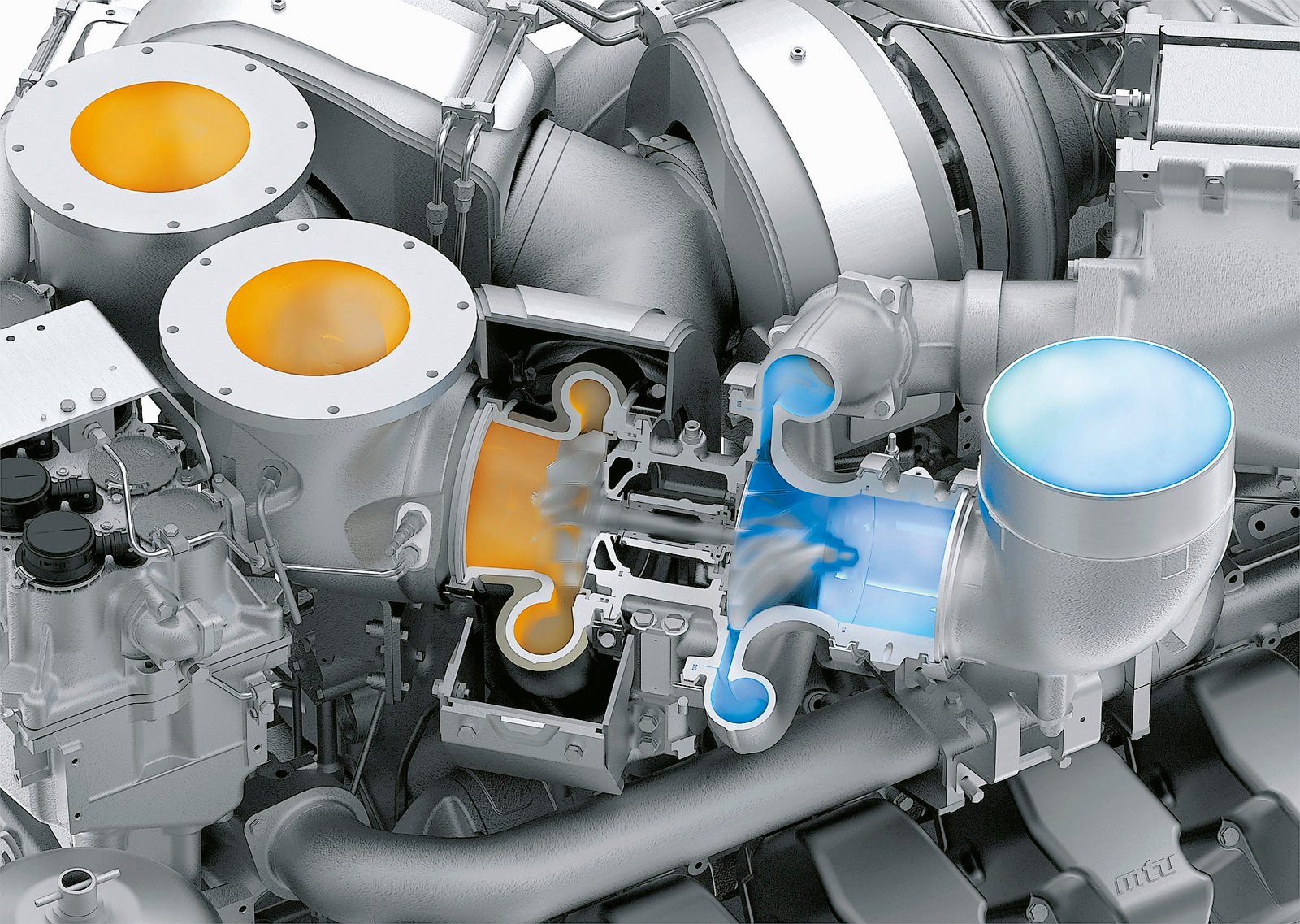
Turbocharging is one of the technologies that allows modern marine diesel engines to produce substantial power from relatively compact engine packages. A turbocharger uses energy contained in the engine’s exhaust gases to drive a turbine connected to a compressor. The compressor then forces more air into the engine, providing the oxygen required to burn an appropriate quantity of fuel and produce additional power. The basic principle is particularly valuable in marine propulsion because vessel engines may need significant power while remaining within practical limits for engine-room space and weight. Modern marine manufacturers use turbocharging alongside electronically controlled fuel injection, combustion management and charge-air cooling to achieve their specified power and efficiency targets.
An intercooler, more precisely called a charge-air cooler in many marine applications, complements the turbocharger by reducing the temperature of compressed intake air before it enters the cylinders. Compressing air increases its temperature, and hotter air is less dense than cooler air at the same pressure. Cooling the compressed air increases its density, allowing more oxygen to enter the cylinder while controlling intake temperature. The result is a closely integrated air-management system in which the turbocharger supplies compressed air and the intercooler conditions that air for combustion. Yanmar’s marine documentation, for example, identifies turbochargers and intake-air coolers within its marine engine cooling and air systems.
How a Marine Turbocharger Works
A turbocharger consists principally of an exhaust-driven turbine and an intake-air compressor connected by a common shaft. As combustion gases leave the cylinders, their energy drives the turbine. The turbine rotates the compressor on the opposite side of the shaft, and the compressor draws in ambient air and increases its pressure before sending it toward the engine’s intake system. The system therefore recovers part of the energy that would otherwise leave through the exhaust and uses it to increase the amount of air available for combustion.
This process allows a diesel engine to generate substantially more power than a naturally aspirated engine of comparable displacement. More air means more oxygen is available, allowing the fuel system to introduce additional fuel while maintaining the combustion conditions required by the engine’s design. The exact turbocharging arrangement varies between engines: some use a single turbocharger, while higher-output engines can employ multiple turbochargers or staged arrangements. Volvo Penta’s larger D11 and D13 marine engines, for example, use advanced turbocharging configurations to support their respective power ranges.
Why Marine Diesels Use Turbocharging
Marine propulsion creates a strong incentive for high power density. Engine compartments have limited space, and adding displacement to obtain more power can increase engine size, weight and installation requirements. Turbocharging allows manufacturers to extract greater power from each cylinder by supplying additional combustion air.
This is particularly important across the power ranges offered by manufacturers such as Yanmar, Volvo Penta, Cummins, Caterpillar, MAN and mtu. Yanmar’s marine portfolio includes turbocharged engines from relatively compact recreational units through much larger commercial propulsion engines, while higher-output manufacturers use increasingly sophisticated air-management systems to achieve substantial power density. Turbocharging is therefore not simply a performance feature; it is fundamental to the architecture of many modern marine diesels.
What Is an Intercooler?
An intercooler is a heat exchanger designed to cool compressed intake air after it has been compressed by the turbocharger and before it reaches the engine cylinders. Because compression raises air temperature, cooling the charge air makes it denser and improves the conditions under which combustion occurs.
In marine engines, the charge-air cooler can be integrated into the vessel’s cooling architecture. Depending on the engine design, cooling may use seawater, freshwater or another manufacturer-specified circuit. Yanmar’s 6LY3 documentation, for example, describes an intercooler within the seawater cooling circuit, while its larger marine systems use dedicated air coolers within the overall cooling arrangement.
Why Cooler Intake Air Matters
The principal benefit of cooling compressed air is increased air density. For a given volume, cooler air contains more oxygen molecules than hotter air. That gives the engine greater control over the relationship between available air and injected fuel.
The result can be higher power, improved combustion control and better thermal management. The charge-air cooler therefore works with the turbocharger and fuel-injection system rather than functioning independently. The engine-management system, turbocharger, injector system and cooling system must all operate within the manufacturer’s calibrated parameters for the engine to deliver its intended performance.
Turbocharging and Fuel Injection Work Together
A turbocharger can provide more air, but additional air alone does not create the engine’s rated power. The fuel system must deliver an appropriate quantity of fuel at the correct timing and pressure. Modern common-rail systems allow the engine control unit to coordinate fuel injection with engine speed, load, intake pressure and other operating parameters.
Yanmar’s common-rail marine technology uses an electronic control unit and multiple sensors to regulate injector operation according to engine conditions. This provides a highly coordinated air-and-fuel system in which turbocharging and fuel injection can respond to changing load conditions. The result is considerably more precise control than older mechanically governed systems could provide.
Boost Pressure
Boost pressure describes the pressure of air supplied by the turbocharger above the pressure that would normally be available from atmospheric intake. Higher boost can allow more air into the cylinders, but boost pressure cannot simply be increased indefinitely because the engine’s pistons, cylinder head, valves, fuel system, turbocharger, cooling system and exhaust system are all engineered around specific operating limits.
Modern marine engines use control strategies to regulate boost and fuel delivery across their operating range. Depending on the engine architecture, this can involve wastegates, variable-geometry turbochargers, electronically controlled fuel injection or multiple turbochargers. The objective is not maximum boost; it is the correct air supply for the engine’s required power, emissions and durability.
Turbocharger Response and Low-Speed Operation
Turbochargers depend on exhaust-gas energy, so their behaviour changes with engine load and RPM. At low engine speed and low load, there may be less exhaust energy available to accelerate the turbine. As load increases, exhaust energy increases and the turbocharger can produce greater boost.
Modern marine engines address this through turbocharger sizing, fuel-control strategies and, on some engines, advanced turbocharger arrangements. The objective is to provide useful torque across the operating range rather than concentrating all the engine’s performance at maximum RPM. This is particularly important in marine propulsion because the engine must respond to changing propeller load, vessel acceleration, sea conditions and manoeuvring demands.
Single vs Multiple Turbochargers
A single turbocharger can provide an efficient and relatively straightforward air-management system for many engines. Higher-output engines may use two or more turbochargers to provide the required volume of air and maintain suitable response across a broader operating range.
Volvo Penta’s larger marine engines provide examples of how turbocharging architecture changes with engine output. The D13 uses a twin-stage turbocharging arrangement on applicable configurations, while smaller marine diesels can use single turbocharger systems. The engineering objective is to achieve the required combination of airflow, boost response, power and efficiency for the specific engine architecture.
Two-Stage Turbocharging
Two-stage turbocharging uses two turbocharging stages to compress intake air progressively. The first stage increases pressure and the second stage increases it further, with charge-air cooling used as required between or after compression stages.
This architecture can allow substantial power output while maintaining effective combustion control across the operating range. Yanmar has documented two-stage turbocharging development for medium-speed marine engines and reported improvements in specific fuel consumption alongside the required emissions performance. The technology illustrates how turbocharging can be optimized not simply for maximum power but for efficiency across demanding marine operating conditions.
Air Intake Restrictions
Turbocharged engines require an unrestricted supply of clean intake air. A blocked or excessively restrictive air filter, damaged intake duct or other restriction can reduce the amount of air available to the turbocharger and ultimately the cylinders.
The result can include reduced engine performance, increased exhaust temperature, smoke and altered turbocharger behaviour. For this reason, air filters, intake ducts and related components form part of routine engine maintenance. Volvo Penta’s support documentation emphasizes following the engine-specific maintenance schedule and using the manufacturer’s service information rather than applying generic intervals.
Charge-Air Cooler Maintenance
The charge-air cooler must remain capable of transferring heat efficiently. In seawater-cooled systems, marine deposits, corrosion, fouling or restricted seawater flow can reduce cooling performance. In an air-side system, contamination can similarly restrict airflow or reduce heat transfer.
A deteriorating charge-air cooler can therefore affect engine performance without any fundamental problem with the fuel system or turbocharger. Diagnosing reduced power or rising temperatures should include the complete air path: air intake, turbocharger, charge-air cooler, intake manifold and combustion chambers.
Seawater Cooling of the Intercooler
Many marine charge-air coolers use seawater because seawater provides an effective heat sink. The seawater circuit can pass through the cooler and remove heat from the compressed intake air before that air enters the engine.
Yanmar’s 6LY3 documentation specifically describes seawater passing through the intercooler and then continuing through other cooling components. This means that a problem with the seawater circuit can affect not only engine coolant temperature but also charge-air temperature and therefore engine performance.
What Happens When the Intercooler Is Restricted?
A restricted charge-air cooler reduces heat-transfer efficiency. As charge-air temperature increases, air density decreases, potentially reducing the amount of oxygen entering the cylinders. Depending on the engine’s control system, the engine may respond by limiting fuel delivery or producing less power to remain within its operating parameters.
A restriction on the seawater side can be particularly important because the same raw-water circuit may serve multiple coolers. A blocked intake, damaged seawater pump, fouled heat exchanger or restricted cooler can therefore produce symptoms that initially appear to be an engine-performance problem. Proper diagnosis should identify whether the restriction exists on the air side or water side of the cooler.
Turbocharger Lubrication
Turbochargers operate at extremely high rotational speeds and temperatures, making proper lubrication essential. Depending on the engine design, the turbocharger receives lubricating oil from the engine’s lubrication system, and oil quality and pressure must remain within specification.
Poor-quality oil, insufficient oil pressure, contamination or extended service intervals can damage turbocharger bearings and other components. This is another reason engine maintenance schedules must be followed precisely. Yanmar states that periodic maintenance intervals vary according to engine application, loads, fuel and lubricating oil, and warns that neglect can impair performance and shorten engine life.
Exhaust Temperature
Exhaust temperature provides important information about combustion and turbocharger operation. Abnormally high exhaust temperatures can indicate problems involving fuel delivery, air supply, cooling, exhaust restriction, overloading or other engine conditions.
Marine engines with multiple cylinders may also be monitored for cylinder-to-cylinder exhaust-temperature differences. Yanmar’s field-service engineering activities specifically include investigation of abnormal exhaust-gas temperatures and increased fuel or lubricating-oil consumption, demonstrating the diagnostic value of these operating parameters.
Turbocharger and Engine Load
The turbocharger responds to engine load because load determines how much fuel is burned and consequently how much exhaust energy is available to drive the turbine. When the vessel accelerates or encounters greater resistance, engine load rises and the turbocharger must supply additional air.
This relationship makes correct propeller matching important. If the propeller places excessive load on the engine, the engine may struggle to reach its rated RPM and the turbocharger may operate outside its intended range. A turbocharger problem and an incorrectly loaded propulsion system can therefore produce similar symptoms, making system-level diagnosis important.
Turbocharger Failure Symptoms
A turbocharger problem can present through loss of power, abnormal exhaust smoke, unusual noise, increased exhaust temperature, reduced boost or increased fuel consumption. None of these symptoms automatically proves that the turbocharger itself has failed.
Air-intake restrictions, exhaust restrictions, fuel-system problems, charge-air leaks and excessive propeller loading can create similar symptoms. Professional diagnosis should therefore establish boost pressure, engine load, exhaust temperature, intake condition and fuel-system performance before replacing the turbocharger.
Charge-Air Leaks
The pressurized air leaving the turbocharger must reach the cylinders without escaping through damaged hoses, clamps, seals or cooler connections. A leak reduces the amount of air available for combustion and can produce reduced power and abnormal engine behaviour.
Leaks can occur anywhere along the pressurized intake path. Depending on the system, this includes turbocharger connections, charge-air coolers, intake piping and manifold interfaces. Regular inspection of hoses and connections is therefore important, particularly on engines experiencing vibration and thermal cycling.
Turbocharger and Fuel Economy
A properly functioning turbocharger contributes to efficient combustion by supplying the engine with the air required for the fuel quantity being injected. If the air system becomes inefficient, combustion can deteriorate and the engine may require more fuel to produce the same useful output.
Fuel economy should therefore be evaluated alongside engine load, boost, exhaust temperature and vessel performance. Volvo Penta states that regular scheduled maintenance and genuine parts help maintain engine performance and fuel efficiency throughout service life, while Yanmar’s technical development programmes explicitly evaluate specific fuel consumption when improving turbocharged marine engines.
Why Turbochargers Matter for Marine Performance
Turbocharging allows marine manufacturers to produce more power from a given engine displacement, making it possible to achieve strong propulsion performance without simply increasing engine size. This is especially valuable in vessels where weight and engine-room dimensions are limited.
The technology also supports modern emissions strategies because precise control of air and fuel is fundamental to combustion management. Modern marine diesels therefore use turbocharging as part of a broader engineering package involving common-rail injection, electronic controls, charge-air cooling and exhaust treatment where required.
Choosing a Turbocharged Marine Diesel
When comparing marine diesel engines, examine more than the advertised horsepower. Important specifications include rated RPM, torque curve, turbocharger configuration, charge-air cooling method, specific fuel consumption, engine weight, duty rating and installation requirements.
For a commercial operator, the engine’s approved duty rating and service support can be as important as the turbocharger architecture. For a recreational owner, compact dimensions, acceleration, fuel efficiency and ease of maintenance may carry greater weight. The correct turbocharged diesel is therefore the one whose complete air-management and combustion system matches the vessel’s actual operating requirements.
Final Perspective
The turbocharger and intercooler are central components of modern marine diesel performance. The turbocharger uses exhaust-gas energy to compress intake air, while the charge-air cooler reduces the temperature of that compressed air before combustion. Together with fuel injection and electronic engine management, they allow manufacturers to achieve high power density, strong torque and efficient combustion from modern marine engines.
Their reliability depends on the entire air, exhaust, fuel and cooling system. Clean intake air, adequate seawater flow where applicable, proper lubrication, healthy charge-air connections, correct engine loading and manufacturer-specified maintenance all contribute to proper operation. Yanmar and Volvo Penta’s technical and maintenance documentation reinforces the same principle: marine-engine performance is sustained through correct system maintenance rather than any single component alone.