
Few marine propulsion technologies have evolved as dramatically as the modern outboard motor. From high-output two-stroke engines that established legendary performance reputations to today’s V8, V10 and V12 four-stroke platforms, the best outboards have consistently pushed the boundaries of power density, reliability, fuel efficiency, control and installation flexibility. This list focuses on 20 of the most significant and capable outboard motors ever produced, combining current flagship engines with historically important models that changed what boaters could expect from an outboard. The selection is not intended to imply that one engine is universally better than another; rather, each represents an important benchmark within its particular class or era.
The engines come from manufacturers including Yamaha, Mercury, Suzuki, Honda, Tohatsu, Evinrude, Seven Marine, OXE Marine and Torqeedo. Some are designed for offshore center consoles and high-performance boats, some for fishing and recreational vessels, some for commercial work, and others for specialized electric or diesel propulsion. Because manufacturers periodically update specifications, discontinue models and vary configurations by market, the figures below are based on manufacturer or authoritative published technical information available at the time of writing and should be verified against the exact model-year specification before purchase or installation.
1. Mercury Marine V12 600 Verado
The Mercury V12 600 Verado is one of the most consequential high-horsepower outboards ever introduced. Its 7.6-liter V12 powerhead broke through the conventional limits of large outboard propulsion while introducing an industry-first two-speed transmission and a steerable gearcase. Rather than simply increasing horsepower, Mercury redesigned the propulsion architecture around the demands of very large boats, allowing the engine to deliver substantial low-speed torque while maintaining efficient high-speed cruising. The contra-rotating propeller system further helps transfer the engine’s substantial output to the water. Mercury describes the 600 Verado as its most powerful outboard and positions it for premium, large-vessel applications.
Key specifications:
* Power: 600 hp
* Displacement: 7.6 L
* Configuration: V12
* Transmission: Automatic two-speed
* Propulsion: Contra-rotating dual propellers
* Gearcase: Independent steerable gearcase
* Controls: Electro-hydraulic / digital
* Fuel: 87-octane gasoline
* Notable technology: Two-speed transmission, Advanced MidSection, SmartCraft integration
2. Yamaha F450 XTO
The Yamaha F450 XTO Offshore established itself as one of Yamaha’s defining high-output outboards. Its 5.6-liter V8 architecture combines direct fuel injection, a 32-valve DOHC cylinder head and a large-displacement powerhead designed specifically for demanding offshore propulsion. Yamaha lists 450 PS at 5,500 rpm and a dry weight range of approximately 447–468 kg depending on configuration. The engine’s digital electronic controls, power trim and tilt and network capability make it suitable for modern multi-engine offshore boats where high thrust, integrated control and long-range operation are important.
Key specifications:
* Power: 450 PS
* Displacement: 5,559 cc
* Configuration: 60° V8
* Valvetrain: DOHC, 32 valves
* Bore × stroke: 96 × 96 mm
* Fuel system: Direct fuel injection
* Rated output speed: 5,500 rpm
* Dry weight: Approximately 447–468 kg
* Controls: Digital Electronic Control
* Trim: Power trim and tilt
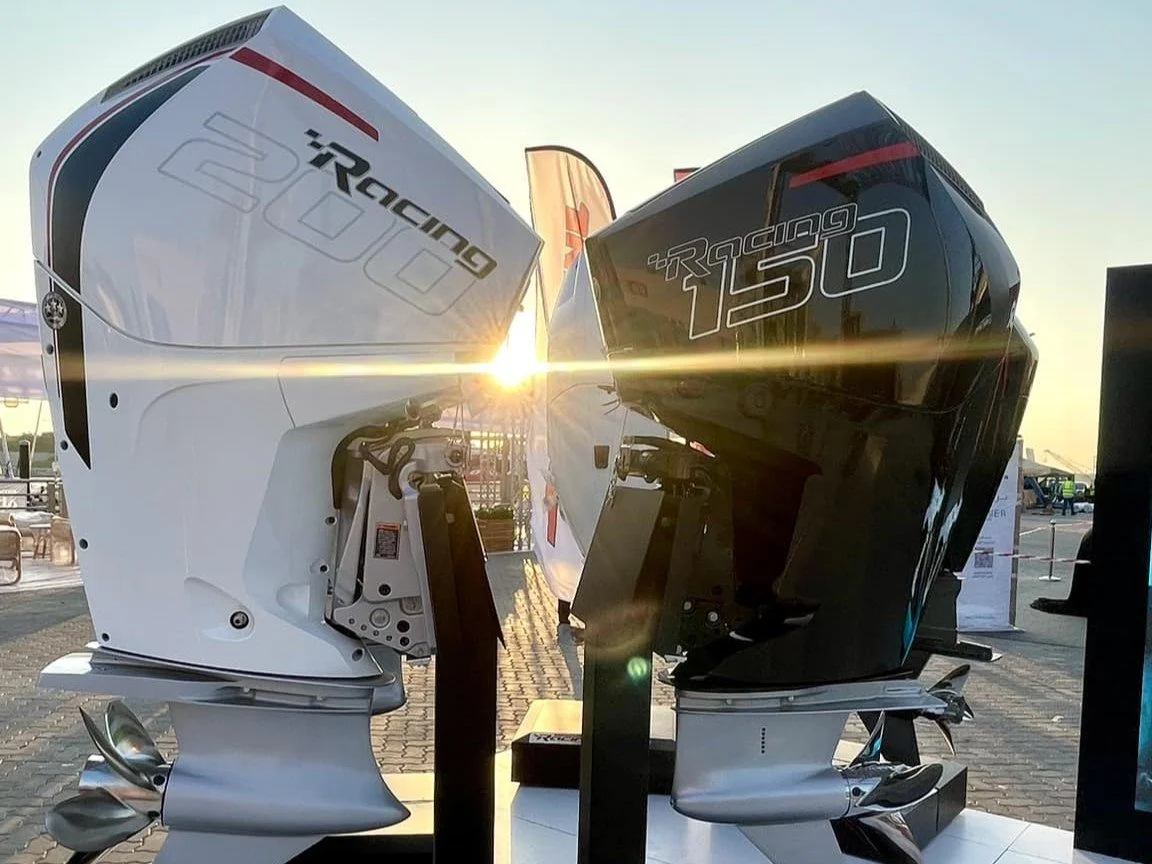
3. Mercury Racing 400R
The Mercury Racing 400R deserves a place among the most influential performance outboards because it demonstrated how far a production-based outboard could be developed for extreme performance applications. The earlier 400R used a 2.6-liter supercharged inline-six platform, producing 400 hp at a remarkable 6,400–7,000 rpm and incorporating advanced electronic fuel injection, electro-hydraulic steering and performance-oriented gearcase options. Mercury Racing engineered it for high-speed applications where power-to-weight ratio, acceleration and precise control mattered more than conventional recreational priorities.
The 400R name has subsequently evolved within Mercury Racing’s product family, with the current-generation 400R using a naturally aspirated 5.7-liter V10. The current model produces 400 hp at 6,000–6,600 rpm, weighs approximately 315 kg and uses Mercury Racing’s QC4 architecture and Sport Master gearcase. This distinction is important when discussing the 400R historically: the specifications depend on which generation of 400R is being referenced.
Current 400R specifications:
* Power: 400 hp / 298 kW
* Configuration: 64° V10
* Displacement: 5.7 L
* Valvetrain: 40-valve DOHC
* WOT range: 6,000–6,600 rpm
* Fuel: 87 octane minimum
* Alternator: 150 A
* Dry weight: Approximately 315 kg
* Gearcase: Sport Master or 5.44-inch HD
* Shaft lengths: 20, 25, 30 and 35 inches
4. Suzuki DF350A
The Suzuki DF350A became a landmark in outboard engineering by combining a 4.39-liter V6 with Suzuki’s Dual Prop System. Rather than relying on a single propeller to absorb the engine’s output, the system uses contra-rotating propellers to improve thrust transfer, stability and reverse performance. Suzuki also incorporated dual fuel injection, a high compression ratio, dual water inlets and electronic Suzuki Precision Control. With 350 hp at 5,700–6,300 rpm and a dry weight around 330 kg in the X configuration, the DF350A established itself as one of the most distinctive 350-hp outboards of its generation.
Key specifications:
* Power: 350 hp / 257.4 kW
* Displacement: 4,390 cc
* Configuration: 55° V6
* Valvetrain: DOHC, 24 valves
* Bore × stroke: 98 × 97 mm
* Fuel system: Electronic fuel injection / dual injection
* Operating range: 5,700–6,300 rpm
* Dry weight: Approximately 330 kg
* Gear ratio: 2.29:1
* Propulsion: Suzuki Dual Prop contra-rotating system
5. Honda BF350
The Honda BF350 represents Honda’s entry into the modern 350-hp V8 outboard class. Honda describes the engine as a 4-stroke 350-hp marine engine designed for applications including pontoons, center consoles and multihull boats. The BF350 is particularly significant because it extends Honda’s traditionally engineering-focused four-stroke marine portfolio into a much higher power category while retaining the company’s emphasis on smoothness, durability and integrated control.
The BF350 is built around a V8 architecture and is offered with modern electronic control systems, making it particularly suitable for contemporary multi-engine boats where precise throttle, shift and steering integration is required. Honda’s current high-power range extends from 115 to 350 hp, placing the BF350 at the top of its conventional outboard family.
Key specifications:
* Power: 350 hp
* Engine type: 4-stroke V8
* Application: Large center consoles, pontoons, multihulls and offshore boats
* Control: Drive-by-Wire / electronic control
* Technology: Honda electronic engine management
* Class: High-power outboard
6. Yamaha VMAX SHO VF250
The Yamaha VMAX SHO VF250 is one of the most influential modern fishing and performance outboards. Yamaha developed the VMAX SHO specifically around the demands of tournament anglers, where rapid acceleration, strong hole shot and high top-end speed are important. The 250-hp version uses a 4.2-liter V6, while Yamaha’s original VF250 introduction incorporated large-bore sleeveless cylinders manufactured using thermal-spray technology to reduce weight while improving heat and wear resistance. Yamaha’s history page identifies the VF250 VMAX SHO as the first outboard to employ this large-diameter sleeveless-cylinder technology.
Key specifications:
* Power: 250 hp
* Displacement: 4,169 cc
* Configuration: 60° V6
* Valvetrain: DOHC, 24 valves
* Bore × stroke: 96 × 96 mm
* Fuel system: Fuel injection
* Rated speed: 5,500 rpm
* Dry weight: Approximately 247–264 kg depending on version
* Application: Bass boats, performance fishing and recreational craft
* Key technology: Large-bore sleeveless cylinders / SHO performance architecture
7. Yamaha F350 V6
The Yamaha F350 V6 is another important Yamaha high-output engine and demonstrates how the company continued developing naturally aspirated V6 architecture beyond the established F300 platform. Yamaha expanded the V6 engine’s piston stroke and increased displacement to approximately 4.3 liters to achieve 350 PS. The engine also incorporates larger intake and exhaust valves and valve-train development influenced by Yamaha’s higher-output offshore engines.
Key specifications:
* Power: 350 PS
* Displacement: Approximately 4.3 L
* Configuration: V6
* Valvetrain: DOHC
* Fuel system: Electronic fuel injection
* Application: High-power offshore and recreational boats
* Design focus: Power, durability and high-output V6 performance
8. Mercury Racing 300R
The Mercury Racing 300R is one of the defining high-performance four-stroke outboards of the modern era. Its naturally aspirated 4.6-liter V8 produces 300 hp at 5,800–6,400 rpm, while Mercury Racing offers Torque Master and Sport Master gearcases for different high-performance hull requirements. The engine uses a 32-valve DOHC architecture, electronic fuel injection, Digital Throttle & Shift or mechanical controls and a heavy-duty short midsection. With a published dry weight of approximately 247 kg in the 15-inch HD CMS configuration, the 300R delivers a strong combination of power, compact packaging and performance-focused engineering.
Key specifications:
* Power: 300 hp / 224 kW
* Configuration: 64° V8
* Displacement: 4.6 L
* Valvetrain: DOHC, 32 valves
* WOT: 5,800–6,400 rpm
* Fuel system: Electronic fuel injection
* Dry weight: Approximately 247 kg
* Gearcases: Torque Master / Sport Master
* Controls: Digital or mechanical
* Fuel: 87-octane minimum
9. Mercury V10 400 Verado
The Mercury V10 400 Verado brought a different philosophy to the 400-hp class than Mercury Racing’s competition-oriented engines. The Verado emphasizes refined operation, torque, quietness, digital integration and premium boating rather than simply maximum racing performance. The current V10 platform uses 5.7 liters of displacement and naturally aspirated architecture, while Mercury incorporates Advanced Range Optimization, Digital Throttle & Shift, Active Trim and optional joystick piloting.
Key specifications:
* Power: 400 hp
* Configuration: V10
* Displacement: 5.7 L
* Valvetrain: DOHC / QC4 architecture
* Fuel: Regular unleaded
* Alternator: Up to 150 A
* Controls: Digital Throttle & Shift
* Technology: Advanced Range Optimization, Active Trim, SmartCraft
* Application: Large center consoles, yachts and premium recreational boats
10. Honda BF250
The Honda BF250 has earned its place among the most respected large four-stroke outboards because it combines a 3.6-liter V6 with Honda’s VTEC and BLAST technologies. Honda introduced the BF250 as a 250-hp flagship in 2011, using a 3.6-liter V6 and a direct air-induction system intended to combine performance with fuel economy. Current specifications list a 3,583 cc V6, 24 valves, electronic programmed fuel injection and a maximum operating range reaching approximately 6,000 rpm.
Key specifications:
* Power: 250 hp
* Displacement: 3,583 cc
* Configuration: 60° V6
* Valvetrain: 24-valve SOHC/DOHC depending on market generation
* Bore × stroke: 89 × 96 mm
* Fuel system: Programmed electronic fuel injection
* Maximum RPM: Approximately 6,000 rpm
* Alternator: Up to 90 A on current specifications
* Technology: VTEC, BLAST, ECOmo
* Weight: Approximately 286 kg in the cited X configuration
11. Suzuki DF300B
The Suzuki DF300B is an especially interesting engine because it shares the Dual Prop concept associated with Suzuki’s flagship DF350A while delivering 300 hp. Its 4.39-liter V6 uses DOHC 24-valve architecture, electronic fuel dual injection, Lean Burn technology and a 2.29:1 gear ratio. Suzuki lists the DF300B at 300 hp with an operating range of 5,500–6,100 rpm and a dry weight of approximately 727 lb in the 25-inch configuration.
Key specifications:
* Power: 300 hp
* Displacement: 4,390 cc
* Configuration: 55° V6
* Valvetrain: DOHC, 24 valves
* Fuel system: Multi-point sequential electronic dual injection
* Operating range: 5,500–6,100 rpm
* Dry weight: Approximately 727 lb / 330 kg
* Gear ratio: 2.29:1
* Propulsion: Contra-rotating dual propellers
* Technology: Lean Burn, oxygen sensor, Suzuki Precision Control
12. Tohatsu BFT250
The Tohatsu BFT250 is one of the most capable high-power engines in Tohatsu’s four-stroke lineup. Its 3.583-liter V6 produces 250 hp, with electronic fuel injection, variable valve timing and lift control, power trim and tilt and a 2.00:1 gear ratio. Tohatsu lists a 5,300–6,300 rpm maximum operating range and a dry weight of approximately 281 kg in its lightest configuration. The engine is particularly relevant to larger fishing boats, center consoles and recreational vessels where Tohatsu’s high-power platform provides a serious alternative to the more commonly discussed Japanese and American brands.
Key specifications:
* Power: 250 hp
* Displacement: 3,583 cc
* Configuration: 60° V6
* Valvetrain: SOHC, 24 valves
* Bore × stroke: 89 × 96 mm
* RPM range: 5,300–6,300 rpm
* Fuel: Unleaded gasoline
* Weight: Approximately 281 kg minimum
* Gear ratio: 2.00:1
* Alternator: 90 A
* Technology: Variable Valve Timing & Lift Control
13. Tohatsu MFS140A
The Tohatsu MFS140A demonstrates why the best outboards cannot be judged exclusively by horsepower. At 140 hp, it sits below the flagship engines on this list, but its combination of 1,995 cc displacement, relatively low weight, fuel efficiency, counter-rotation availability and strong electrical output makes it a highly versatile mid-range platform. Tohatsu lists a dry weight of approximately 178 kg, a 41-amp alternator, electronic fuel injection, a 2.08:1 gear ratio and a 5,150–5,850 rpm operating range.
Key specifications:
* Power: 140 hp / 103 kW
* Displacement: 1,995 cc
* Configuration: 4-cylinder
* Bore × stroke: 84 × 90 mm
* RPM range: 5,150–5,850 rpm
* Fuel system: Electronic fuel injection
* Weight: Approximately 178 kg
* Gear ratio: 2.08:1
* Alternator: 41 A
* Technology: Variable Idle System, counter-rotation option
14. Evinrude E-TEC G2 300
The Evinrude E-TEC G2 300 is included because its technology was one of the most significant departures from conventional four-stroke outboard design in the modern era. BRP’s G2 platform used a 3.4-liter 74-degree V6 direct-injection two-stroke architecture and integrated digital shift and throttle, Dynamic Power Steering and i-Trim. BRP stated that the G2 range delivered substantial torque and efficiency improvements relative to competing four-stroke engines in its internal comparisons. The 300-hp model used E-TEC direct injection with stratified low-RPM combustion and produced 300 hp across a 5,400–6,000 rpm full-throttle range.
Evinrude subsequently exited the new outboard-engine manufacturing business, so the E-TEC G2 is now primarily a historically significant and used-market engine, rather than a current-production choice. That does not diminish its engineering importance; the G2 represented one of the most sophisticated high-output two-stroke outboard platforms of its generation.
Key specifications:
* Power: 300 hp
* Displacement: 3.4 L
* Configuration: 74° V6
* Engine type: Direct-injection two-stroke
* Bore × stroke: 98 × 76 mm
* RPM range: 5,400–6,000 rpm
* Fuel system: E-TEC direct injection
* Gear ratio: 1.85:1
* Controls: Integrated digital shift and throttle
* Alternator output: Up to 133 A
15. Seven Marine 627
The Seven Marine 627 deserves a special place in any historical discussion of outboard motors. Seven Marine challenged the industry’s conventional horsepower ceiling by adapting a 6.2-liter supercharged V8 powerhead derived from General Motors’ automotive technology and pairing it with a ZF Marine transmission and purpose-built marine systems. The resulting 627-hp engine was introduced in 2015 and briefly occupied the extraordinary position of being one of the most powerful production outboards ever offered.
The Seven Marine story is historically important because the company demonstrated that very large outboard propulsion could move beyond traditional outboard powerheads and use automotive-derived high-performance V8 technology in a marine package. Seven Marine outboards went out of production in early 2021, making the 627 a discontinued but highly notable piece of modern outboard history.
Key specifications:
* Power: 627 hp
* Displacement: 6.2 L
* Configuration: Supercharged V8
* Powerhead origin: GM-derived 6.2-liter architecture
* Transmission: ZF Marine computer-controlled disc-clutch system
* Application: Large yachts and high-performance offshore boats
* Status: Discontinued
* Historical significance: One of the highest-output production outboards ever built
16. OXE300 Diesel Outboard
The OXE300 stands apart from almost every conventional outboard on this list because it uses a turbocharged diesel powerhead rather than a gasoline marine engine. OXE developed the platform around commercial and demanding applications where torque, fuel economy, range and diesel-fuel commonality are important. The current OXE300 DL6 uses a 3.0-liter inline-six diesel with bi-turbocharging and produces 300 hp, while OXE lists peak torque of up to 945 Nm at the propeller and compatibility with diesel fuels including EN 590, B7 and HVO100.
The engine is particularly interesting for government, transport, patrol, search-and-rescue and commercial operators because it combines outboard installation with diesel propulsion characteristics. OXE also emphasizes its high alternator output and modular rigging approach, making the engine more than a simple propulsion unit for operators who require substantial onboard electrical capacity.
Key specifications:
* Power: 300 hp
* Engine: Diesel inline 6
* Displacement: 3.0 L
* Aspiration: Bi-turbo / turbocharged and intercooled
* Torque: Up to 945 Nm
* Rated power speed: 4,000–4,200 rpm
* Weight: Approximately 430 kg in current DL6 specification
* Alternator: 180 A
* Fuel: Diesel, B7, EN 590, HVO100
* Leg lengths: 25 or 33 inches
* Gear ratio: 1.39:1
17. Torqeedo Cruise 12.0
The Torqeedo Cruise 12.0 is included because the history of the outboard motor is no longer exclusively about gasoline and diesel. Electric propulsion has become a serious part of modern marine engineering, and the Cruise 12.0 is an important example of a high-output electric outboard designed for boats, dinghies and commercial applications. Torqeedo rates the system at 12,000 watts input power and describes it as approximately equivalent to a 25-hp gasoline outboard in propulsive performance. It operates on a 48-volt system and uses a built-in GPS and onboard computer when paired with the appropriate TorqLink control system.
The Cruise 12.0 is particularly significant because it demonstrates the growing importance of electric propulsion for applications where low noise, zero local exhaust emissions and precise digital energy management are valuable. Torqeedo’s published data lists approximately 59.8 kg for the short-shaft remote-steering motor without batteries and a recommended battery configuration using two Power 48-5000 units.
Key specifications:
* Input power: 12 kW
* Propulsive power: 6.72 kW
* Gasoline-equivalent: Approximately 25 hp
* Voltage: 48 V
* Motor weight: Approximately 59.8–62.5 kg without battery
* Control: Remote throttle
* System: TorqLink
* Battery: Recommended 2 × Power 48-5000
* Integrated computer: Yes
* Drive: Stepless forward/reverse
18. Torqeedo Deep Blue 50 R
The Torqeedo Deep Blue 50 R represents another major step in electric outboard propulsion. Unlike the smaller Cruise platform, Deep Blue is a high-voltage integrated propulsion system designed for demanding leisure and commercial applications. Torqeedo lists the Deep Blue 50 R at 50 kW continuous shaft power and a 60 kW peak system output, with approximately 80-hp equivalent propulsive performance. The system uses a high-voltage battery architecture, integrated electronics and sophisticated onboard monitoring.
The Deep Blue system demonstrates why electric outboards are increasingly being evaluated as complete propulsion systems rather than simply electric replacements for small gasoline engines. Torqeedo integrates the motor, electronics, battery management, display and charging architecture into a coordinated system, while the company reports maximum overall efficiency of approximately 54% for the system.
Key specifications:
* Continuous shaft power: 50 kW
* Peak shaft power: 55 kW
* Comparable combustion outboard: Approximately 80 hp
* Nominal voltage: Approximately 350 V
* Maximum propeller speed: Approximately 2,440 rpm
* Motor weight: From approximately 139 kg including electronics
* Battery options: Deep Blue Battery 40 / 80
* Cooling: Direct water cooling
* Controls: Electronic remote control
* Application: Commercial and premium electric marine propulsion
19. Yamaha F300 V6
The Yamaha F300 has become one of the most recognizable large-displacement Yamaha outboards because it combines a 4.169-liter V6 with a relatively compact package and Yamaha’s established reliability-focused engineering. Yamaha’s current published specifications list 300 PS at 5,500 rpm, a 24-valve DOHC V6 architecture and fuel injection, with dry weight beginning around 263 kg depending on configuration. The engine is offered with digital electronic control on appropriate variants and power trim and tilt.
The F300 is particularly important because it occupies a highly practical performance category. It provides enough output for substantial center consoles and offshore boats without reaching the extreme weight, complexity and fuel requirements associated with the largest V8, V10 and V12 outboards.
Key specifications:
* Power: 300 PS / 220.6 kW
* Displacement: 4,169 cc
* Configuration: 60° V6
* Valvetrain: DOHC, 24 valves
* Bore × stroke: 96 × 96 mm
* Rated speed: 5,500 rpm
* Fuel system: Fuel injection
* Dry weight: Approximately 263–276 kg depending on model
* Controls: Digital Electronic Control on applicable models
* Trim: Power trim and tilt
20. Mercury Verado 350
The Mercury Verado 350 is a significant member of Mercury’s premium high-horsepower family and represents the point where refined luxury-oriented propulsion meets serious offshore performance. Current Verado 350/400 models use Mercury’s 5.7-liter V10 architecture, with the V10 platform emphasizing torque, smooth operation, digital controls and fuel optimization. Mercury’s current specifications identify the 350 and 400 hp Verado engines as naturally aspirated V10s using 5.7 liters of displacement and calibrated for standard unleaded fuel.
The Verado philosophy is particularly relevant to owners who spend significant time at the helm and want more than raw horsepower. Digital Throttle & Shift, Advanced Range Optimization, Active Trim and optional joystick systems allow the propulsion package to become an integrated part of the vessel’s control architecture. This combination of power, refinement and electronic integration is a major reason the Verado family has become one of the defining modern premium outboard platforms.
Key specifications:
* Power: 350 hp
* Configuration: V10
* Displacement: 5.7 L
* Aspiration: Naturally aspirated
* Fuel: 91 RON / 87-octane-class regular unleaded
* Alternator: High-output charging system
* Controls: Digital Throttle & Shift
* Technology: Advanced Range Optimization, Active Trim, SmartCraft
* Application: Offshore center consoles, yachts and premium recreational boats
Quick Comparison: 20 Standout Outboard Motors
# Outboard Manufacturer Power Displacement Configuration Distinguishing Feature
1 V12 600 Verado Mercury 600 hp 7.6 L V12 2-speed transmission
2 F450 XTO Yamaha 450 PS 5.6 L V8 Direct injection
3 400R Mercury Racing 400 hp 5.7 L current V10 Sport Master / racing technology
4 DF350A Suzuki 350 hp 4.39 L V6 Dual Prop
5 BF350 Honda 350 hp — V8 Honda high-power V8
6 VF250 VMAX SHO Yamaha 250 hp 4.169 L V6 SHO performance architecture
7 F350 V6 Yamaha 350 PS ~4.3 L V6 High-output V6
8 300R Mercury Racing 300 hp 4.6 L V8 Performance gearcases
9 V10 400 Verado Mercury 400 hp 5.7 L V10 Refined premium propulsion
10 BF250 Honda 250 hp 3.583 L V6 VTEC / BLAST
11 DF300B Suzuki 300 hp 4.39 L V6 Contra-rotating props
12 BFT250 Tohatsu 250 hp 3.583 L V6 Variable valve technology
13 MFS140A Tohatsu 140 hp 1.995 L I4 Lightweight mid-range
14 E-TEC G2 300 Evinrude 300 hp 3.4 L V6 2-stroke Direct injection
15 Seven Marine 627 Seven Marine 627 hp 6.2 L Supercharged V8 Historic high-power milestone
16 OXE300 OXE Marine 300 hp 3.0 L Diesel I6 High-torque diesel outboard
17 Cruise 12.0 Torqeedo 25-hp equivalent 12 kW input Electric 48-V electric propulsion
18 Deep Blue 50 R Torqeedo 80-hp equivalent 50 kW shaft Electric High-voltage system
19 F300 V6 Yamaha 300 PS 4.169 L V6 Proven high-output V6
20 Verado 350 Mercury 350 hp 5.7 L V10 Premium digital propulsion
What Makes an Outboard “One of the Best”?
There is no technically defensible way to declare one outboard the best for every boat. The Mercury V12 600 Verado, for example, is extraordinary for very large vessels requiring extreme outboard horsepower, but its size and complexity make it inappropriate for a small fishing boat. Similarly, the lightweight Tohatsu MFS140A may be a better engineering choice for a particular vessel than a 600-hp V12 simply because its power, weight and installation requirements are properly matched to the hull. The manufacturer’s own specifications demonstrate this enormous range, from compact engines through 600-hp high-output systems.
The most important criteria are therefore power-to-weight ratio, torque delivery, fuel consumption, operating RPM, reliability, corrosion protection, cooling, gear ratio, propeller compatibility, electronic controls, service availability and the vessel’s intended duty cycle. For performance boats, acceleration and power density may dominate the decision. For offshore fishing, corrosion resistance, charging capacity and reliability can be more important. For commercial work, torque, fuel consumption, uptime and serviceability may outweigh outright horsepower. Electric systems introduce an entirely different set of considerations involving battery capacity, charging infrastructure, range and energy management.
Gasoline, Diesel or Electric?
The modern outboard market is no longer confined to gasoline four-stroke engines. The OXE300 demonstrates how diesel technology can be packaged into an outboard for commercial and government applications, with high torque and diesel-fuel compatibility. Torqeedo’s Cruise and Deep Blue systems demonstrate the progression toward electric propulsion, with integrated battery and energy-management technology. Meanwhile, engines such as the Yamaha F450 XTO, Mercury V12 Verado, Suzuki DF350A and Honda BF350 represent the current evolution of high-output gasoline propulsion.
This diversity is ultimately positive for boat owners because propulsion can now be selected around the mission of the vessel rather than simply the maximum horsepower available. A tournament bass boat, offshore center console, luxury yacht, commercial patrol craft and environmentally sensitive electric vessel can all require fundamentally different propulsion solutions.
Final Perspective
The 20 engines above represent some of the most important milestones in modern outboard development. From the Seven Marine 627’s historic assault on the horsepower ceiling and the Evinrude E-TEC G2’s sophisticated direct-injection two-stroke architecture to the Mercury V12 600 Verado’s two-speed transmission, Yamaha XTO’s V8 offshore platform, Suzuki’s Dual Prop system, OXE’s diesel outboard technology and Torqeedo’s high-voltage electric systems, each engine demonstrates a different solution to the fundamental challenge of converting compact power into reliable marine propulsion.
The phrase “best outboard motor of all time” therefore depends on what the engine is being asked to accomplish. For maximum production horsepower, the Mercury V12 600 is in a class of its own among the engines covered here. For offshore gasoline propulsion, Yamaha, Mercury, Honda and Suzuki offer exceptionally strong high-power platforms. For high-performance applications, Mercury Racing remains a benchmark. For commercial diesel propulsion, OXE offers an unusual combination of outboard installation and diesel torque. And for electric propulsion, Torqeedo demonstrates how rapidly the definition of an outboard is changing. The best engine is ultimately the one whose power, weight, torque, propulsion system, fuel or energy source, technology and duty cycle are correctly matched to the vessel.