
A marine diesel exhaust system performs two essential functions: safely removing combustion gases from the engine and managing the heat, noise and emissions produced during operation. Unlike a road vehicle, a marine engine must discharge exhaust through a vessel installation that can be exposed to seawater, confined engine spaces and strict installation limitations. The system therefore has to control exhaust temperature and back pressure while preventing exhaust gases or seawater from entering areas where they can damage the engine or create a hazard. Modern marine engines can also incorporate emissions-control equipment such as selective catalytic reduction (SCR), depending on the engine, vessel and applicable regulations. Yanmar’s marine documentation, for example, specifies maximum allowable exhaust back pressure and operating temperature for its 6LY SCR system, showing how closely exhaust design is connected to engine performance.
Exhaust technology has also become increasingly important as marine emissions regulations have tightened. Regulations can address pollutants including nitrogen oxides (NOx), particulate matter (PM), hydrocarbons and sulfur oxides (SOx), with requirements varying according to engine size, vessel type, construction date and operating region. Yanmar’s 4LV development incorporated electronically controlled common-rail injection and combustion optimization to meet EPA Tier 3 and European requirements, while its larger marine engines use SCR technology for applicable IMO Tier III applications.
What a Marine Exhaust System Does
The exhaust system collects combustion gases leaving the engine cylinders and directs them safely outside the vessel. It must provide an unobstructed path for exhaust flow while keeping exhaust temperature, noise and pressure within the engine manufacturer’s specified limits.
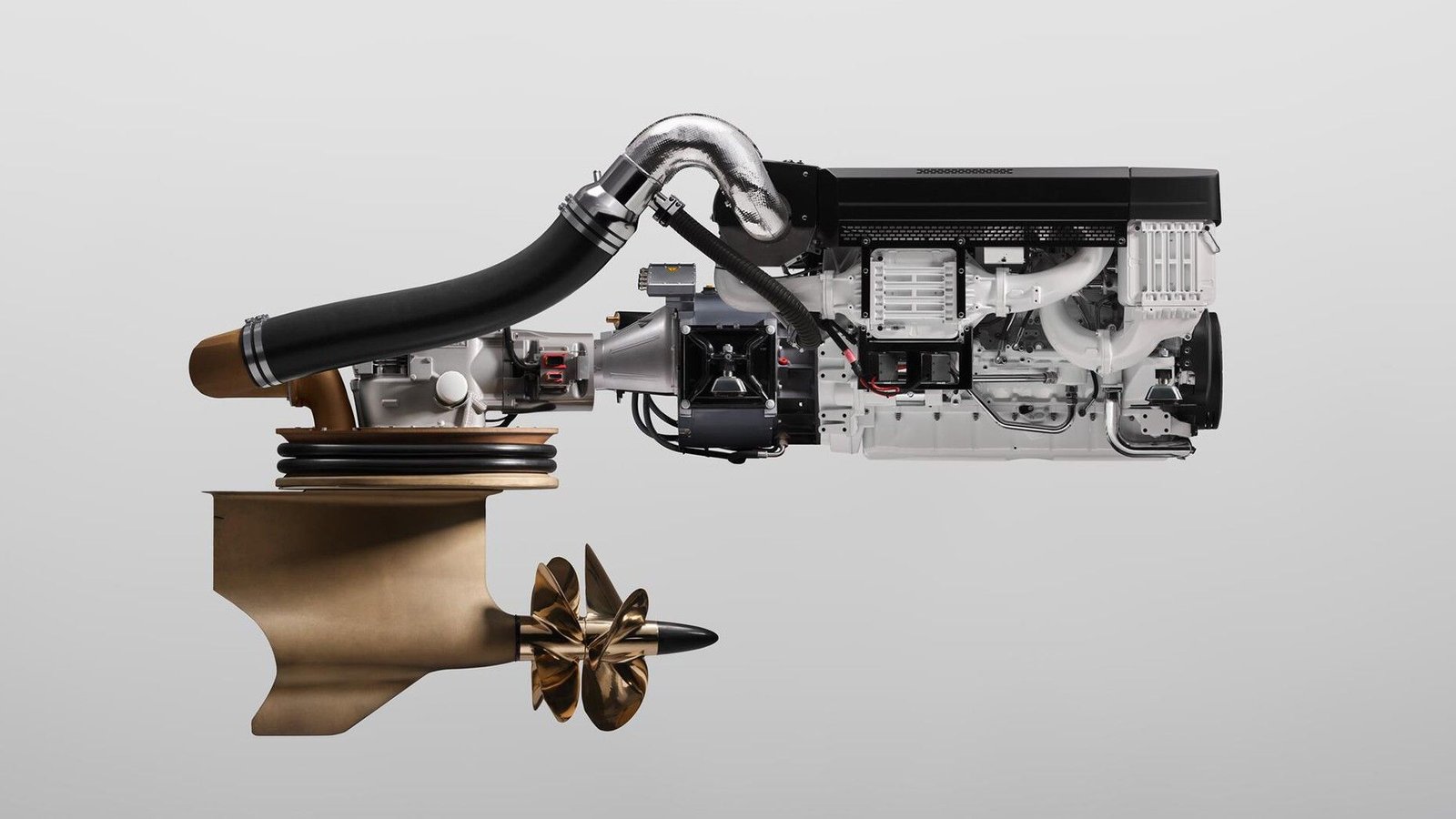
The system normally includes components such as the exhaust manifold, turbocharger outlet where applicable, exhaust elbow or mixing section, muffler or silencer, piping and outlet. The exact configuration depends on whether the engine uses a wet or dry exhaust arrangement and on the vessel’s installation. The exhaust system must be designed around the engine’s specified flow and back-pressure limits rather than simply using piping of convenient dimensions.
Wet Exhaust Systems
Wet exhaust systems introduce cooling water into the exhaust stream, reducing exhaust-gas temperature before the gases leave the vessel. This is particularly useful on recreational and smaller commercial vessels where compact exhaust arrangements and lower external exhaust temperatures are desirable.
The water is normally introduced after the engine’s exhaust manifold and turbocharger, depending on the engine design. The exact injection point is critical because seawater must never be allowed to enter the engine through an incorrectly designed exhaust system. Yanmar’s marine systems incorporate seawater cooling into the exhaust arrangement and provide specific installation requirements to control water flow and prevent water ingress.
Dry Exhaust Systems
Dry exhaust systems keep cooling water separate from the exhaust gases. The exhaust piping remains dry and is normally insulated to control surface temperature and protect surrounding engine-room components.
Dry systems are particularly relevant to larger commercial and industrial marine installations where exhaust temperatures, routing and vessel configuration justify a dedicated exhaust architecture. They can provide substantial flexibility for large installations, but insulation, expansion, supports and ventilation must be engineered carefully because exhaust components can reach very high temperatures.
Exhaust Back Pressure
Exhaust back pressure is one of the most important exhaust-system specifications. Every engine is designed to operate within a defined exhaust-pressure range. Excessive resistance downstream of the engine can restrict the removal of combustion gases and affect turbocharger operation, engine performance, exhaust temperature and fuel consumption.
This is why exhaust pipe diameter, length, bends, mufflers, aftertreatment equipment and outlet configuration all matter. Yanmar’s 6LY SCR system, for example, specifies a maximum exhaust back pressure of 30 kPa and publishes pressure-drop data for the SCR assembly. The final exhaust system must therefore be engineered to remain within the engine manufacturer’s permitted pressure limit.
Why Exhaust Temperature Matters
Exhaust temperature provides important information about combustion and engine loading. The exhaust leaving a diesel cylinder contains significant thermal energy, and turbocharged engines use part of that energy to drive the turbocharger.
Excessive exhaust temperature can indicate several possible conditions, including excessive engine load, inadequate air supply, fuel-system problems, restricted exhaust flow or cooling-system issues. It should therefore be evaluated alongside engine RPM, boost pressure, load and other operating parameters rather than treated as an isolated measurement.
Exhaust Manifolds
The exhaust manifold collects gases from the individual cylinders and directs them toward the turbocharger or exhaust outlet. It is exposed to high temperatures and repeated thermal expansion and contraction, making material selection and installation important.
On turbocharged engines, exhaust-gas energy is used to drive the turbine before the gases continue into the exhaust system. This makes the manifold and turbocharger part of the engine’s overall air-management system. A restriction or leak in this area can affect both exhaust flow and turbocharger performance.
Mufflers and Silencers
Marine exhaust systems can incorporate mufflers or silencers to reduce exhaust noise before the gases leave the vessel. This is particularly important on recreational vessels, passenger craft and installations where engine noise must be controlled for comfort and operational requirements.
Muffler selection must still account for exhaust flow and allowable back pressure. A silencer that reduces noise but creates excessive resistance can negatively affect engine performance. The correct component therefore needs to be selected according to the engine manufacturer’s exhaust specifications.
Exhaust and Seawater
Wet exhaust systems create a direct relationship between the exhaust and seawater cooling systems. Seawater can cool the exhaust gases after they leave the engine, but its entry point and routing must be carefully controlled.
A poorly designed system can allow water to travel backward toward the engine when the engine is stopped, particularly where the exhaust outlet and engine are positioned relative to the vessel’s waterline. This is why marine exhaust installations can require water-injection elbows, anti-siphon arrangements, risers or other manufacturer-approved components.
Preventing Water Ingress
Water entering a marine diesel through the exhaust system can cause severe engine damage. The risk is particularly important on installations where the engine exhaust outlet is near or below the vessel’s waterline.
Volvo Penta identifies vacuum valves for applicable installations and explains that they prevent siphoning through the seawater intake and subsequent water ingress. The exact arrangement depends on the engine and vessel, but the principle is universal: the exhaust and cooling-water system must prevent seawater from reaching the cylinders.
Exhaust Risers and Water Injection
An exhaust riser can raise the exhaust-water mixing point above the appropriate level relative to the engine and vessel waterline. This helps reduce the possibility of seawater flowing backward into the engine.
The correct height and configuration are engine-specific. Increasing or decreasing the riser height without following the manufacturer’s installation specifications can alter exhaust back pressure and cooling-water behaviour. Exhaust installation should therefore be treated as an engineered system rather than a simple pipe-routing exercise.
Exhaust Emissions
Marine diesel combustion produces several regulated pollutants. The most significant categories include NOx, particulate matter, hydrocarbons and sulfur-related emissions, depending on the fuel and regulatory framework.
Modern engine manufacturers address emissions through a combination of combustion optimization, electronically controlled fuel injection and exhaust aftertreatment. Yanmar’s 6GY135, for example, uses a common-rail system and was developed to meet emissions requirements across Japan, Europe, the United States and China while maintaining low fuel consumption.
NOx Emissions
Nitrogen oxides are produced during high-temperature combustion and are a major focus of marine emissions regulations. The IMO’s Tier III requirements impose substantially tighter NOx limits in designated emission-control areas than earlier standards.
Manufacturers can reduce NOx through combustion strategies and, where required, aftertreatment systems such as SCR. Yanmar’s marine SCR technology uses urea solution and a catalyst to convert NOx into nitrogen and water, with the company reporting reductions of 80% or more for its SCR technology.
Selective Catalytic Reduction
SCR is one of the principal technologies used to reduce NOx from modern marine diesel exhaust. The system injects an aqueous urea solution, commonly called DEF or diesel exhaust fluid, into the exhaust. The fluid produces ammonia, which reacts with NOx across a catalyst and converts it primarily into nitrogen and water.
Volvo Penta’s IMO Tier III system uses SCR and states that its solution can reduce NOx by up to 75%. Cummins similarly uses SCR aftertreatment on applicable QSK38 and QSK60 marine engines to meet EPA Tier 4 and IMO III requirements.
DEF and Urea Systems
An SCR-equipped marine engine requires more than the catalyst itself. The system can include a DEF tank, dosing pump, injector, sensors, control unit, mixing section and SCR catalyst. DEF concentration and quality must meet the applicable specification because incorrect fluid can affect system performance.
Yanmar’s 6LY SCR system, for example, specifies DEF at 32.5% concentration according to AUS32 and ISO 22241 and publishes a maximum DEF consumption of 3% at maximum load. These requirements demonstrate why SCR should be treated as an integrated engine-management system rather than simply an exhaust muffler.
EPA Marine Emissions Standards
Marine engines sold or operated in the United States can be subject to EPA emissions requirements depending on engine category and application. Manufacturers develop engines and aftertreatment systems specifically around these requirements.
Yanmar’s 4LV series, for example, was developed with electronically controlled common-rail injection and combustion optimization to comply with EPA Tier 3 and European requirements. Current higher-output commercial engines can require more advanced aftertreatment, including SCR, to satisfy stricter standards.
IMO Marine Emissions Standards
The International Maritime Organization regulates marine air pollution through MARPOL Annex VI, including NOx requirements for applicable marine diesel engines. IMO Tier III requirements apply to designated NOx Emission Control Areas and are significantly more stringent than Tier II.
Yanmar developed SCR systems specifically for IMO Tier III applications, while Volvo Penta and Cummins also offer marine engines and aftertreatment systems designed for applicable IMO Tier III requirements.
Emissions Control Is Engine-Specific
Not every marine diesel requires SCR, and not every vessel operates in an area where the same emissions requirements apply. The correct emissions configuration depends on the engine’s rated power, certification, vessel application, construction requirements and operating region.
For example, Yanmar’s 6LY SCR solution is offered for specific 6LY configurations and publishes exact operating limits for the SCR system. Cummins’ QSK38 and QSK60 Tier 4 packages similarly identify their specific EPA and IMO certifications. The exact certification should therefore always be verified against the specific engine model rather than assumed from the manufacturer name.
Exhaust Aftertreatment
Aftertreatment refers to technology installed downstream of the engine to modify or remove pollutants from exhaust gases. SCR is one example, but different engines can use different combinations of in-cylinder controls and exhaust technologies.
Caterpillar’s 3516E commercial propulsion engine, for example, combines a fuel-efficiency-optimized engine with SCR aftertreatment and is available in configurations meeting U.S. EPA Tier 4 and IMO II/III requirements. This demonstrates the direction of modern commercial marine propulsion: emissions compliance is increasingly integrated into the complete power package.
Exhaust System and Engine Performance
A marine exhaust system must balance emissions control, noise reduction, cooling and unrestricted gas flow. Adding components without considering their pressure drop can compromise engine performance.
This becomes particularly important when installing SCR systems, larger mufflers or replacement exhaust components during repowering. Yanmar’s published SCR data includes pressure-drop measurements specifically because the aftertreatment system becomes part of the engine’s total exhaust resistance. Every component must therefore remain within the engine manufacturer’s approved limits.
Exhaust Smoke
Visible smoke can provide useful diagnostic information, although smoke colour alone cannot identify a fault conclusively. Black smoke can be associated with incomplete combustion or an insufficient air-to-fuel relationship, while blue or blue-white smoke can indicate oil consumption or other combustion-related conditions.
Yanmar’s 4LV development specifically addressed blue-white and black smoke through optimized combustion and common-rail fuel injection, reporting significant reductions compared with previous engines. Persistent abnormal smoke should therefore be investigated rather than dismissed as a normal characteristic of diesel engines.
Exhaust Leaks
Exhaust leaks are both a performance and safety concern. A leak before the turbocharger can reduce the energy available to the turbine and affect boost, while a leak within the engine room can expose occupants and equipment to hot exhaust gases.
Exhaust components should therefore be inspected for cracks, damaged gaskets, loose connections, corrosion and other signs of deterioration. The inspection is particularly important around manifolds, turbocharger connections, elbows and exhaust joints where thermal cycling is severe.
Exhaust System Maintenance
Maintenance should include inspection of exhaust hoses, clamps, elbows, mufflers, water-injection points, risers and other components specified by the engine manufacturer. Wet systems require particular attention to corrosion, water flow and the condition of components exposed to seawater.
SCR-equipped engines add additional maintenance requirements involving DEF quality, dosing components, sensors and the SCR catalyst system. Cummins, Volvo Penta and Yanmar all integrate aftertreatment into applicable marine packages, meaning the emissions system becomes part of the overall propulsion-maintenance programme.
Exhaust Systems During Repowering
Repowering is one of the situations where exhaust design deserves particular attention. A replacement engine may have a different exhaust-flow requirement, turbocharger arrangement, outlet location, back-pressure limit or emissions system than the original engine.
The existing exhaust should therefore never be assumed to be compatible simply because the replacement engine has similar horsepower. The new installation should be evaluated for pipe diameter, routing, back pressure, water-injection location, riser height, muffler capacity, outlet position and emissions equipment.
Final Perspective
A marine diesel exhaust system is a critical part of the propulsion package, not merely a method of getting combustion gases outside the boat. The system must manage exhaust flow, temperature, back pressure, noise, seawater interaction and emissions while protecting the engine from water ingress and excessive restriction.
Modern marine engines increasingly combine optimized combustion with sophisticated aftertreatment. Yanmar uses common-rail combustion technology and SCR on applicable engines, Volvo Penta offers SCR systems for IMO Tier III applications, Cummins uses SCR on applicable Tier 4/IMO III engines, and Caterpillar integrates SCR into selected commercial propulsion packages.
For vessel owners, the central principle is straightforward: the exhaust system must be designed around the exact engine and vessel installation. Correct back pressure, adequate cooling, proper water-injection arrangements and applicable emissions certification are essential to achieving reliable, compliant and efficient marine propulsion.