

Choosing between a single and twin outboard installation is fundamentally a question of boat size, propulsion requirements, operating profile, redundancy, handling, weight, and total ownership cost. A single engine is mechanically simpler, generally lighter, less expensive to purchase and maintain, and well suited to a wide range of recreational and smaller commercial vessels. Twin engines provide greater combined propulsion, additional manoeuvrability, and a degree of operational redundancy, but introduce additional weight, rigging, maintenance, fuel-system requirements, and purchase cost. Yamaha’s current marine systems support single through quad-engine configurations, while its Helm Master EX platform specifically integrates control of twin, triple, and quad outboards, demonstrating how multi-engine installations have become sophisticated propulsion systems rather than simply two engines mounted on one transom.
The decision should therefore begin with the boat manufacturer’s approved engine configuration and total horsepower capacity, followed by an assessment of how the vessel will actually be used. A single outboard can be the most efficient solution when one engine provides sufficient power for the boat’s normal load and operating conditions. Twin outboards become increasingly attractive on larger vessels where total power requirements, offshore operating considerations, low-speed manoeuvrability, or redundancy justify the additional complexity. Suzuki’s published dual-engine technology also demonstrates how counter-rotation can improve steering balance, trim, and thrust characteristics in twin installations.
Single Outboard Advantages
A single outboard provides the simplest propulsion configuration. One engine means one powerhead, one gearcase, one propeller, one set of engine controls, and fewer associated components to maintain. For boats within the appropriate horsepower range, this simplicity can reduce acquisition cost, installation complexity, routine servicing, and long-term maintenance requirements.
Weight is another significant advantage. A single engine can leave more capacity for passengers, fuel, equipment, and other onboard systems, particularly on smaller boats where propulsion weight represents a substantial percentage of total displacement. Yamaha identifies outboards generally as space-efficient propulsion systems, and modern high-output models are engineered specifically to balance power with compactness and weight.
Twin Outboard Advantages
Twin outboards provide two independent propulsion units, allowing the boat to distribute its required horsepower across two engines. This can be particularly useful on larger hulls where the total power requirement exceeds what a practical single installation can provide or where the vessel is specifically designed around multiple engines.
Twin configurations can also improve low-speed manoeuvrability because the engines can produce thrust independently and, on compatible systems, can be controlled together through integrated digital steering and throttle systems. Yamaha’s Helm Master EX, for example, supports integrated control of twin, triple, and quad outboards and can coordinate steering, shifting, throttle, and joystick manoeuvring.
Redundancy and Offshore Operation
One of the strongest arguments for twin engines is propulsion redundancy. If one engine becomes unavailable, a properly configured twin-engine vessel may retain propulsion from the remaining engine. This can be particularly valuable for offshore operations where returning safely to harbour may otherwise be difficult.
Redundancy should not, however, be interpreted as a guarantee that a twin-engine boat can always continue normal operation after an engine failure. The remaining engine may not provide enough power to maintain the vessel’s normal cruising performance, and steering, electrical, fuel, and control-system dependencies still need to be considered. The actual level of redundancy depends on the vessel’s complete engineering configuration.
Handling and Manoeuvrability
Twin outboards can provide useful manoeuvring advantages because the engines can generate different thrust levels and directions. At low speeds, differential thrust can assist turning and docking, particularly when integrated with modern digital control systems.
Counter-rotation is another important consideration. Suzuki explains that when two conventional propellers rotate in the same direction, the boat can develop a corresponding steering tendency. Counter-rotating propellers address this effect by rotating in opposite directions, providing straighter steering, more balanced thrust, and improved trim characteristics.
Twin Engines and Total Power
Twin engines allow the total rated horsepower to be distributed across two propulsion units. For example, a boat designed for a 600 hp total installation could potentially use two 300 hp outboards rather than one 600 hp engine, where the hull manufacturer approves that configuration.
Suzuki’s DF300B is an example of an outboard developed for single through quad installations and designed around 300 hp total per engine. Suzuki specifically highlights its contra-rotating propeller system for acceleration, low-speed manoeuvring, and performance on large, heavily loaded vessels.
However, total horsepower should never be calculated independently of the boat’s capacity. The manufacturer must approve the multi-engine configuration, including total power, engine spacing, shaft length, weight, steering, and mounting arrangement.
Weight and Transom Loading
Twin engines can add substantial weight to the stern. Two engines naturally require more propulsion mass than one engine of comparable individual output, and the complete installation also includes additional controls, steering components, rigging, and associated systems.
This is particularly important on smaller or lighter vessels. The transom must be structurally designed for the combined engine weight and dynamic loads. The boat’s published maximum engine rating and installation specifications should therefore be checked before considering a twin conversion or repower.
Fuel Consumption
Twin engines do not automatically consume twice as much fuel in every operating condition, because fuel consumption depends on throttle position, engine loading, hull speed, propeller efficiency, and the specific engines involved. Nevertheless, two engines introduce additional mechanical and fuel-system capacity and may increase overall fuel demand when both are operating under comparable loads.
The more meaningful comparison is fuel consumed per nautical mile at the vessel’s normal cruising speed and load. A twin installation can sometimes provide efficient cruising when each engine operates within a favourable load range, while a single engine may offer lower total consumption on a smaller vessel where one engine is already appropriately matched to the hull.
Maintenance Requirements
A twin-engine boat effectively has two propulsion systems to maintain. Oil, filters, spark plugs, gearcase lubricant, water-pump components, anodes, propellers, batteries, controls, and other service items can all be duplicated depending on the installation.
That does not necessarily make twin ownership impractical. For owners who value redundancy, performance, or offshore capability, the additional maintenance may be justified. The important point is to include both routine and long-term servicing costs when comparing single and twin configurations rather than considering only the initial engine price.
Installation and Rigging
Twin installations require careful attention to engine spacing, steering, controls, electrical systems, fuel delivery, batteries, propellers, and transom structure. Digital engine-management systems have made multi-engine control considerably more sophisticated, but they also mean that proper system integration becomes increasingly important.
Yamaha’s current Helm Master EX system illustrates this integration, combining digital electronic control with multi-engine steering, throttle, shifting, and joystick functions. Yamaha also specifies that certain hydraulic steering configurations require a tie bar for twin installations, demonstrating that the installation hardware can differ materially from a single-engine setup.
Single vs Twin for Smaller Boats
For smaller recreational boats, tenders, fishing boats, and vessels where one engine can comfortably provide the manufacturer’s approved horsepower, a single outboard is often the more rational configuration. Lower weight, lower acquisition cost, simpler rigging, and fewer service requirements can make a single engine particularly attractive.
The key is sufficient power. A single engine should not be undersized simply to reduce cost. If the boat regularly operates with heavy passenger or equipment loads, in challenging water, or at speeds requiring substantial power reserves, the manufacturer’s approved higher-output single option may be preferable.
Single vs Twin for Larger Offshore Boats
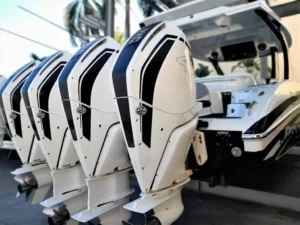
Larger offshore centre consoles, fishing vessels, commercial boats, and high-performance craft are more likely to benefit from twin or multiple engines. The advantages become more relevant as total horsepower requirements increase and the value of propulsion redundancy and low-speed control rises.
Modern multi-engine systems can also provide highly integrated helm control. Yamaha’s Helm Master EX supports twin through quad applications, while Suzuki’s high-output twin-propeller technology demonstrates how propulsion systems can be engineered specifically around large, heavily loaded boats.
Twin Engines and Counter-Rotation
Counter-rotation deserves particular attention when selecting twin engines. With conventional propellers rotating in the same direction, propeller torque can influence steering and vessel behaviour. Counter-rotating configurations use opposite propeller rotation to balance the thrust forces.
Suzuki explains that its dual-engine counter-rotation approach can provide straighter steering, more level trim, balanced thrust, and reduced torque effects. On certain high-output Suzuki engines, contra-rotating propellers are integrated into the engine itself, distributing torque across two propellers and allowing a more hydrodynamically efficient gearcase design.
Twin Does Not Always Mean Better
The additional capabilities of a twin installation come with additional compromises. More weight, higher purchase cost, more components, increased servicing requirements, greater rigging complexity, and potentially higher fuel consumption all need to be justified by the boat’s actual operating requirements.
A properly matched single outboard can outperform the overall ownership proposition of an unnecessarily complex twin setup. Conversely, fitting a single engine to a boat designed around twin propulsion can compromise performance, handling, or redundancy. The correct answer therefore comes from the vessel’s engineering requirements rather than a blanket preference for one configuration.
How to Choose Between Single and Twin
Choose a single outboard when the boat’s approved horsepower range can be satisfied comfortably by one engine and simplicity, weight, cost, and straightforward maintenance are important priorities.
Consider twin outboards when the vessel is designed for multiple engines and the additional propulsion, redundancy, manoeuvrability, or offshore capability provides a meaningful operational advantage. Before purchasing, compare total horsepower, engine weight, transom capacity, shaft length, propeller configuration, steering, controls, fuel systems, maintenance, and expected operating costs.
The best configuration is ultimately the one that provides the required performance without exceeding the vessel’s structural or operational limits. A single engine can be exceptionally capable when correctly matched, while a properly engineered twin installation can transform the performance and control of a larger vessel. What matters is matching the propulsion architecture to the boat and the mission.