
The propeller is the final component that converts an outboard’s available engine power into usable thrust, making its selection just as important as choosing the engine itself. Propeller performance is determined by several interacting factors, including diameter, pitch, blade count, blade geometry, material, engine RPM, gear ratio, hull design, vessel weight, and intended use. Mercury explains that propeller selection involves substantially more than pitch and diameter, with features such as cup, rake angle, and blade-edge design also influencing performance.
A correctly selected propeller should allow the outboard to operate within the manufacturer’s specified wide-open-throttle RPM range while providing the desired balance of acceleration, cruising performance, efficiency, and top-end speed. There is no single propeller that is ideal for every boat using the same engine because hull design, load, and operating conditions change the result. Tohatsu’s official propeller selection guidance specifically notes that boat hull design, carrying load, and individual application can produce differences in performance.
Understanding Propeller Pitch
Pitch is the theoretical distance a propeller would advance during one revolution if it were moving through a solid medium without slip. It is normally expressed in inches, so a propeller marked 14 × 19 has a 14-inch diameter and 19-inch pitch. Mercury explains that increasing pitch generally reduces wide-open-throttle engine RPM, while reducing pitch generally increases RPM, assuming other factors remain unchanged.
Pitch therefore has a direct relationship with acceleration and engine loading. A higher-pitch propeller can favour higher-speed performance when the engine has sufficient power to turn it correctly, while a lower-pitch propeller can improve acceleration and load-carrying performance. The objective is not simply to select the highest or lowest pitch, but to choose a pitch that allows the engine to reach its prescribed operating range under the intended load.
Understanding Propeller Diameter
Diameter is the overall diameter of the circle created by the rotating blade tips. It is determined by the propeller’s design, engine characteristics, gear ratio, power delivered to the propeller, and intended application. Mercury notes that diameter generally increases for slower, heavier boats where additional blade area can help generate the thrust required to move greater loads, while faster boats commonly use smaller diameters to reduce drag.
Diameter should therefore be considered as part of the complete propeller design rather than adjusted independently without regard to the manufacturer’s recommendations. Propeller manufacturers develop diameter, pitch, blade area, and geometry together for particular propulsion applications. Tohatsu’s official propeller charts likewise list diameter and pitch alongside blade count and application information for its engines.
Three-Blade vs Four-Blade Propellers
Blade count can influence the balance between acceleration, grip, efficiency, vibration, and top-end performance. Three-blade propellers are widely used across outboard applications and can provide a strong overall balance of speed and acceleration. Four-blade designs provide additional blade area and can be advantageous in applications where stronger low-speed grip, improved load carrying, or particular handling characteristics are desired.
There is no universal rule that a four-blade propeller is better than a three-blade propeller. The appropriate choice depends on the hull, engine, gear ratio, load, and intended operation. Yamaha currently offers both three- and four-blade propeller designs within its outboard accessory range, while Suzuki’s published propeller specifications vary by engine and application.
Aluminium vs Stainless Steel Propellers
Material affects durability, weight, rigidity, cost, and the way a propeller responds under load. Aluminium propellers are widely used because they provide a practical and economical solution across many recreational applications. Stainless steel propellers are substantially stronger and can support more refined blade designs, allowing manufacturers to engineer specific performance characteristics for demanding applications.
Material alone, however, does not determine performance. Mercury’s current propeller range demonstrates that geometry, blade design, cup, rake, and edge shape all contribute to the final result. The appropriate material should therefore be selected according to the boat’s application, operating environment, expected exposure to impacts, desired performance, and overall ownership priorities.
Propeller Selection and Engine RPM
One of the most important checks after fitting a propeller is whether the engine reaches the manufacturer’s specified wide-open-throttle RPM range under the appropriate test conditions. Propeller pitch has a direct effect on engine RPM: Mercury explains that excessive pitch can prevent the engine from reaching the lower end of its recommended range, while insufficient pitch can allow RPM to rise above the permitted range. Either condition can compromise performance and potentially cause engine or drivetrain damage.
This makes an RPM check essential when changing propeller specifications. A propeller should not be selected solely because it fits physically or because its dimensions resemble the original propeller. The engine’s recommended RPM range, actual vessel load, water conditions, and performance results should all be considered. Mercury specifically recommends testing the boat on the water after installing a new propeller.
Matching the Propeller to Your Boat
The same outboard can require different propeller specifications on different boats. Hull shape, displacement, passenger load, fuel capacity, equipment, cruising requirements, and intended use all influence how much thrust the vessel requires and how efficiently the propeller operates. Tohatsu’s official propeller chart explicitly states that differences in hull design, carrying load, and specific use can affect performance.
For that reason, propeller selection should begin with the complete boat-and-engine combination. A propeller that performs well on a lightly loaded recreational boat may not provide the desired acceleration or load-carrying capability on a heavier fishing or commercial vessel using the same horsepower. The correct propeller is the one that delivers the desired operating characteristics while keeping the engine within its prescribed RPM range.
Propeller Design Beyond Pitch and Diameter
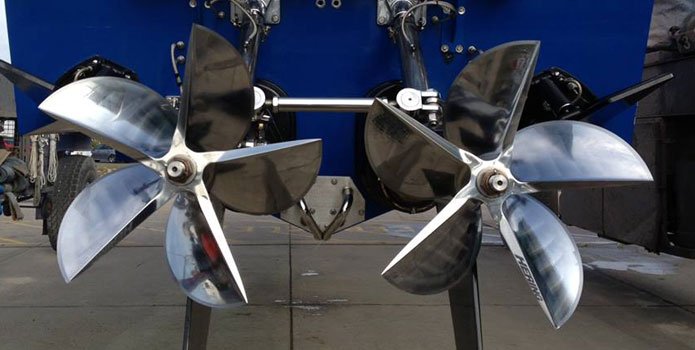
Modern propellers are engineered with considerably more variables than the two numbers stamped on the hub. Cup, rake, blade area, blade thickness, edge geometry, and overall blade shape can all affect how the propeller interacts with the water. Mercury specifically identifies cup, rake angle, and edge shape as important elements of propeller performance.
These design characteristics allow manufacturers to develop propellers for particular applications rather than relying on a single universal design. High-speed boats, heavily loaded vessels, offshore applications, and boats requiring strong acceleration can benefit from different propeller geometries. Consequently, choosing a propeller by pitch alone can overlook important performance differences between otherwise similar-looking products.
When Should You Change Your Propeller?
A propeller may require replacement because of physical damage, corrosion, excessive wear, or changes to the vessel’s operating requirements. A bent or damaged blade can affect balance and performance, while damage around the blade edges can reduce the propeller’s ability to produce consistent thrust. Regular inspection is particularly important for vessels operating in shallow water or areas where submerged objects are a risk.
Propeller changes can also be worthwhile when the existing setup does not provide the desired acceleration, cruising performance, load carrying, or engine RPM. Mercury describes correct propeller selection as one of the straightforward ways to improve boat performance and offers dedicated selection tools based on boat type, usage, engine, and other application information.
Selecting the Right Propeller
The best starting point is the outboard manufacturer’s recommended propeller specifications for the specific engine, followed by an assessment of the boat’s hull, operating weight, normal cruising conditions, and intended use. From there, pitch, diameter, blade count, material, and propeller geometry can be evaluated against the desired performance. Existing performance data, including wide-open-throttle RPM, can be particularly useful when replacing or refining an existing setup.
A properly selected propeller should allow the engine to operate within its specified range while delivering the performance characteristics the boat actually needs. Instead of choosing a propeller based on appearance, price, or one specification alone, treat it as part of the complete propulsion system. That approach produces a better balance of acceleration, efficiency, cruising performance, engine protection, and long-term reliability.