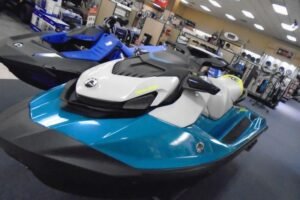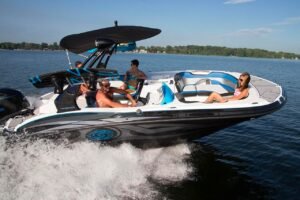

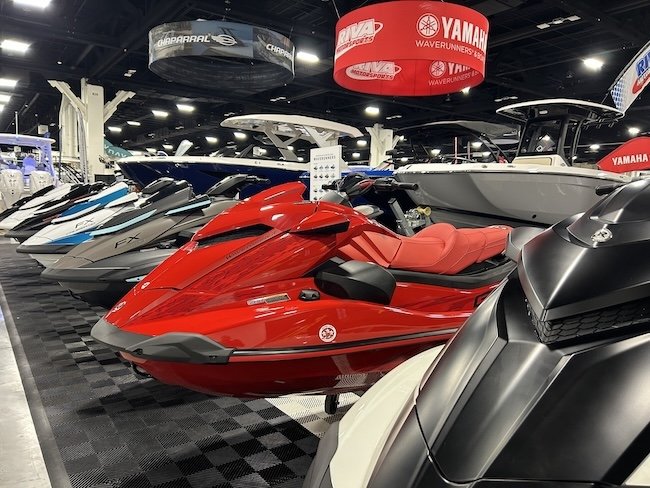
Personal watercraft have developed far beyond the traditional recreational “jet ski” concept. Today’s PWC market includes lightweight entry-level machines, family-oriented three-passenger craft, offshore touring models, competition-focused performance machines, fishing platforms and increasingly sophisticated electric watercraft. Although Jet Ski is Kawasaki’s trademarked product name, the broader technical category is personal watercraft (PWC), while Yamaha uses WaveRunner and BRP uses Sea-Doo.
For 2026, the strongest brands are not necessarily identical in philosophy or product breadth. Sea-Doo stands out for the breadth of its recreational, touring, performance, tow-sports and fishing portfolio; Yamaha WaveRunner combines an exceptionally broad lineup with established four-stroke marine-engine technology and dedicated performance and freestyle models; Kawasaki Jet Ski remains particularly strong in performance, deep-V handling and supercharged propulsion. Taiga occupies a rapidly developing electric-PWC category, while Belassi represents an ultra-low-volume, handcrafted high-performance approach centered around its turbocharged Burrasca. The ranking below therefore considers product breadth, engineering significance, performance specialization, technology and the ability to serve different types of riders rather than simply comparing horsepower.
1. Sea-Doo
Sea-Doo is arguably the most comprehensive PWC manufacturer in the 2026 market. Its portfolio covers nearly every major recreational application, from the compact Spark and Spark Trixx through GTI recreational models, GTX touring machines, high-performance RXP-X and RXT-X models, Wake tow-sports craft and the dedicated FishPro fishing range. That breadth is one of Sea-Doo’s greatest competitive advantages because the brand does not force buyers into a single design philosophy. Instead, its platforms are divided into clearly defined categories according to how the watercraft is intended to be used.
Sea-Doo’s performance lineup also reaches the highest levels of modern PWC propulsion, with the 2026 GTR-X 300, RXP-X and RXT-X using supercharged Rotax power. At the other end of the range, the Spark provides a relatively compact and accessible entry point. Between those extremes are touring, family, tow-sports and fishing platforms, making Sea-Doo particularly strong for households or operators who want several different types of PWC within one manufacturer’s ecosystem.
Why Sea-Doo ranks first
The primary reason Sea-Doo takes the No. 1 position is product breadth and specialization. Its 2026 portfolio is explicitly organized into six major categories: Rec Lite, Recreation, Touring, Performance, Tow Sports and Sport Fishing. This is more than a marketing classification; the individual platforms have substantially different purposes, hull characteristics, seating arrangements, storage configurations and equipment packages.
Sea-Doo also has one of the industry’s strongest examples of purpose-built PWC specialization with the FishPro family. Rather than simply adding fishing accessories to a recreational machine, Sea-Doo integrates features such as fishing-oriented storage, rod holders, cooler arrangements and Garmin marine electronics into dedicated models. That makes the brand particularly compelling for buyers who want one PWC platform to perform a specialized role.
Complete 2026 Sea-Doo PWC lineup
Rec Lite
* 2026 Spark
* 2026 Spark Trixx
Recreation
* 2026 GTI
* 2026 GTI SE
Touring
* 2026 GTX
* 2026 GTX Limited
* 2026 Explorer Pro
Performance
* 2026 GTR
* 2026 GTR-X
* 2026 RXP-X
* 2026 RXT-X
Tow Sports
* 2026 Wake
* 2026 Wake Pro
Sport Fishing
* 2026 FishPro Scout
* 2026 FishPro Sport
* 2026 FishPro Trophy
That gives the U.S. 2026 Sea-Doo range 17 listed model variants across six categories. Model availability, naming and specifications can differ between countries, so the U.S. lineup should not automatically be treated as the worldwide catalog.
2. Yamaha WaveRunner
Yamaha WaveRunner is one of the most established names in the PWC industry and remains one of the strongest choices for riders looking for a combination of performance, versatility and established marine-engine engineering. Yamaha’s 2026 lineup is particularly notable because it spans lightweight JetBlaster models, VX recreational craft, full-size FX luxury models, GP performance machines, the stand-up SuperJet and the new CrossWave concept. Yamaha’s current product structure therefore covers a remarkably broad range of recreational and performance requirements.
One of Yamaha’s important advantages is the range of propulsion systems used across its lineup. Depending on the model, Yamaha employs the three-cylinder TR-1 and TR-1 High Output engines, a 1.9-liter four-cylinder High Output engine and the supercharged 1.8-liter Super Vortex High Output engine. Yamaha specifically positions the GP Series around high-performance riding, while the FX family emphasizes full-size comfort, technology and long-distance usability.
Why Yamaha ranks second
Yamaha’s strongest characteristic is balance. The company does not concentrate exclusively on supercharged performance or entry-level recreational machines. Instead, it maintains a mature product architecture covering lightweight personal watercraft, family-oriented recreational models, luxury touring craft, race-oriented machines and stand-up freestyle watercraft. The 2026 CrossWave expands this philosophy further by introducing a PWC-style platform with a large walkaround deck, substantial storage and a broader lifestyle orientation.
Yamaha also retains a dedicated stand-up PWC in the SuperJet, something that distinguishes its lineup from many mainstream manufacturers. The SuperJet uses Yamaha’s three-cylinder four-stroke TR-1 marine engine and is specifically designed around freestyle and stand-up riding rather than conventional three-person recreational operation.
Complete 2026 Yamaha WaveRunner lineup
Rec Lite — JetBlaster Series
* JetBlaster
* JetBlaster DLX 2-Up
* JetBlaster DLX 3-Up
* JetBlaster PRO 2-Up
* JetBlaster PRO 3-Up
* JetBlaster LTD
Recreation — VX Series
* VX-C
* VX
* VX Deluxe
* VX Cruiser
* VX Cruiser HO
* VX Limited
* VX Limited HO
Luxury — FX Series
* FX HO
* FX Cruiser HO
* FX SVHO
* FX Cruiser SVHO
* FX Limited SVHO
Performance — GP Series
* GP HO
* GP SVHO
Freestyle
* SuperJet
CrossWave
* CrossWave
Yamaha’s current official catalog displays 22 WaveRunner/PWC products in its U.S. product finder.
3. Kawasaki Jet Ski
Kawasaki occupies a unique position in the PWC industry because Jet Ski is actually the company’s trademarked product name, making Kawasaki the manufacturer most directly associated with the term. More importantly, Kawasaki has retained a distinctive engineering philosophy centered on strong acceleration, deep-V hulls, performance-oriented handling and, at the top of the range, supercharged four-cylinder propulsion.
The 2026 Kawasaki range is concentrated more tightly than Sea-Doo or Yamaha, but that is not necessarily a weakness. Kawasaki focuses heavily on three-passenger recreational and performance machines, with the Ultra family representing its premium offshore-oriented platform. The Ultra 160 uses a naturally aspirated 1,498 cc inline-four, while the Ultra 310 employs Kawasaki’s supercharged and intercooled version of the same basic displacement class.
Why Kawasaki ranks third
Kawasaki’s major advantage is performance-oriented engineering combined with a relatively focused lineup. The Ultra platform uses a 22.5-degree deep-V hull, and Kawasaki equips its current models with technologies including Kawasaki Smart Reverse with Deceleration, electronic cruise control, power modes and modern TFT instrumentation. The Ultra 160 LX models additionally receive features such as integrated storage, smartphone connectivity, LED lighting and, on the LX, a JETSOUND audio system and adjustable ERGO-FIT seating.
The Ultra 310 remains Kawasaki’s flagship performance family. Its supercharged, intercooled 1,498 cc inline-four is aimed at riders who prioritize high-output acceleration and top-end performance. Kawasaki therefore remains one of the strongest choices for enthusiasts who place performance above having the industry’s largest number of specialized recreational variants.
Complete 2026 Kawasaki Jet Ski lineup
ST Series
* 2026 Jet Ski ST 160X
STX Series
* 2026 Jet Ski STX 160X
* 2026 Jet Ski STX 160LX
Ultra 160 Series
* 2026 Jet Ski Ultra 160LX-S
* 2026 Jet Ski Ultra 160LX
Ultra 310 Series
* 2026 Jet Ski Ultra 310LX-S
* 2026 Jet Ski Ultra 310LX
Kawasaki’s official 2026 materials identify the Ultra 160 and Ultra 310 families as the principal flagship series, while the current model database lists the ST, STX and Ultra variants above.
Important model-year distinction: the SX-R 160 and Ultra 160LX-S Angler appear in Kawasaki’s broader website and comparison database as previous model-year products, but they should not be incorrectly presented as 2026 models simply because they remain visible on Kawasaki’s website. The current 2026 model listings identify the ST/STX/Ultra variants above.
4. Taiga Motors
Taiga represents one of the most important changes occurring in the PWC industry: the movement from conventional gasoline propulsion toward purpose-built electric personal watercraft. Unlike manufacturers that have historically built gasoline PWCs and then considered electrification as an additional technology, Taiga was founded around electric powersports. Its Orca watercraft therefore approaches propulsion from an entirely different engineering perspective, using an electric powertrain, battery system and connected electronics rather than an internal-combustion engine and conventional fuel system.
Taiga’s 2026 development is particularly significant because the company began customer deliveries of the new Orca WX3, a three-seat electric PWC, in May 2026. Taiga stated that it had completed production and delivery of its 2026 Orca P2 run before beginning production ramp-up for the WX3. The company also announced the beginning of mass-produced electric PWC deliveries to European customers during 2026.
Why Taiga ranks fourth
Taiga earns its position because of electric-PWC specialization and technological differentiation. Its Orca platform demonstrates that electric propulsion can be engineered into a full-size personal watercraft rather than being limited to small low-speed recreational craft. The company has also developed connected functionality and bidirectional charging capability for the new WX3, giving its 2026 platform characteristics that are fundamentally different from traditional gasoline PWCs.
The Orca P2 provides a particularly interesting performance benchmark. Published 2026 specifications identify an electric powertrain capable of up to 160 hp, with lithium-ion energy storage, multiple charging options and connected digital features. Meanwhile, the WX3 expands the concept into a three-seat crossover platform intended for family recreation and watersports.
Taiga’s 2026 watercraft products
Taiga’s official product catalog currently lists:
* Orca P2
* Orca WX3
* Orca Carbon Limited Edition
The Orca P2 represents the performance-oriented two-person platform, the WX3 is the new three-seat crossover watercraft, and the Carbon Limited Edition represents Taiga’s premium limited-production Orca configuration. Taiga’s official product page also lists Nomad models, but those are electric snowmobiles rather than personal watercraft, so they should not be included in a PWC product list.
The distinction is important for accurate marine publishing: Taiga is a broader electric powersports company, but its Orca family is its personal-watercraft product line.
5. Belassi
Belassi occupies a very different position from Sea-Doo, Yamaha and Kawasaki. It is not a high-volume manufacturer attempting to compete across every mainstream PWC category. Instead, the Austrian company focuses on handcrafted, high-performance personal watercraft, with its Burrasca Marine Hypercraft representing an unusually specialized combination of turbocharged propulsion, composite construction and extensive customization.
The Burrasca uses a 1,602 cc turbocharged four-stroke engine producing 320 hp, with a water-cooled intercooler, stainless-steel jet pump and adjustable trim system. Belassi lists a dry weight of 367 kg and a two-person capacity, while its handcrafted construction incorporates resin-infused fiberglass, carbon fiber and CNC-machined aluminum components. The manufacturer states that each Burrasca is individually machined, assembled and customized rather than produced as a conventional mass-market PWC.
Why Belassi ranks fifth
Belassi earns a place among the five because it demonstrates how far specialized PWC performance and craftsmanship can be taken. Its Burrasca is not competing directly with a $10,000 to $20,000 mainstream recreational PWC. Instead, it targets buyers interested in exclusivity, high power-to-weight performance, handcrafted construction and extensive personalization. Belassi states that more than 2,000 components are involved in the Burrasca and that the craft undergoes extensive assembly and testing before delivery.
The company’s turbocharged architecture is also unusual within the modern PWC market. Belassi describes the Burrasca as the only stock turbocharged PWC on the global market, while its published technical data identifies 320 hp from the 1.602-liter engine. The company also operates a separate Marine Power Unit division developing compact turbocharged marine powertrains for PWC and jet-boat applications, extending its engineering beyond the Burrasca itself.
Complete Belassi PWC product lineup as of 2026
Marine Hypercraft
* Belassi Burrasca
The Burrasca is the company’s current dedicated personal watercraft. Belassi’s other major marine product is the Marine Power Unit (MPU), but this is an engine/powertrain product intended for PWC and compact jet-boat integration rather than a complete consumer PWC. It should therefore be listed separately from the company’s finished watercraft.
2026 Comparison of the Five Best PWC Brands
Rank Brand Primary Strength 2026 Product Breadth Propulsion Focus
1 Sea-Doo Broadest specialization Very broad Gasoline
2 Yamaha WaveRunner Balance, versatility & performance Very broad Gasoline
3 Kawasaki Jet Ski Performance & deep-V handling Focused Gasoline
4 Taiga Electric PWC technology Specialized Electric
5 Belassi Handcrafted high performance Ultra-specialized Turbocharged gasoline
Which PWC Brand Is Best for Different Riders?
There is no technically sound answer that makes one manufacturer universally superior. Sea-Doo is arguably the strongest all-round choice for someone who wants the greatest variety of purpose-built models, particularly because its 2026 range includes recreational, touring, performance, tow-sports and fishing machines. Its model architecture allows a buyer to select a PWC around the intended activity instead of adapting one general-purpose machine to every use case.
Yamaha is particularly compelling for buyers who value breadth, established marine engineering and a mixture of recreational and performance choices. Its 2026 range extends from the compact JetBlaster family to the full-size FX series and competition-oriented GP models, while the SuperJet preserves a dedicated stand-up platform.
Kawasaki is particularly attractive to performance-oriented riders, especially those interested in the Ultra platform and its deep-V hull, high-output propulsion and electronic handling technologies. Its lineup is narrower than Sea-Doo’s or Yamaha’s, but the company concentrates heavily on performance-oriented three-passenger machines.
Taiga is the natural specialist for riders specifically interested in electric propulsion. Its 2026 Orca program demonstrates that battery-electric PWC technology has moved beyond prototypes into customer deliveries and international commercial availability. The limitations are different from those of gasoline PWCs, particularly around charging infrastructure, range and energy availability, so the propulsion choice needs to match the rider’s operating pattern.
Belassi is aimed at an entirely different buyer. The Burrasca is a boutique performance machine rather than a conventional family PWC. Its 320-hp turbocharged engine, handcrafted composite construction and extensive customization make it particularly relevant to collectors, high-performance enthusiasts and buyers seeking exclusivity rather than maximum practicality or broad dealer availability.
Final Verdict
The 2026 PWC market is best understood as five different approaches to personal watercraft engineering. Sea-Doo leads through exceptional product breadth and specialization; Yamaha combines a mature, extensive lineup with recreational, luxury, performance and freestyle platforms; Kawasaki concentrates its expertise around performance-oriented Jet Ski models; Taiga represents the transition toward electric personal watercraft; and Belassi demonstrates what is possible when PWC engineering is taken into an ultra-low-volume, handcrafted performance category.
For a general-purpose buyer, Sea-Doo and Yamaha offer the broadest range of solutions. For a performance-focused rider, Kawasaki, Yamaha’s GP models, Sea-Doo’s RXP-X/RXT-X and Belassi’s Burrasca occupy different points on the performance spectrum. For someone specifically seeking electric propulsion, Taiga is one of the most significant dedicated PWC manufacturers to watch in 2026. The correct choice ultimately depends on hull design, propulsion system, intended use, rider capacity, range requirements, service infrastructure, storage, operating environment and total ownership requirements rather than horsepower alone.