
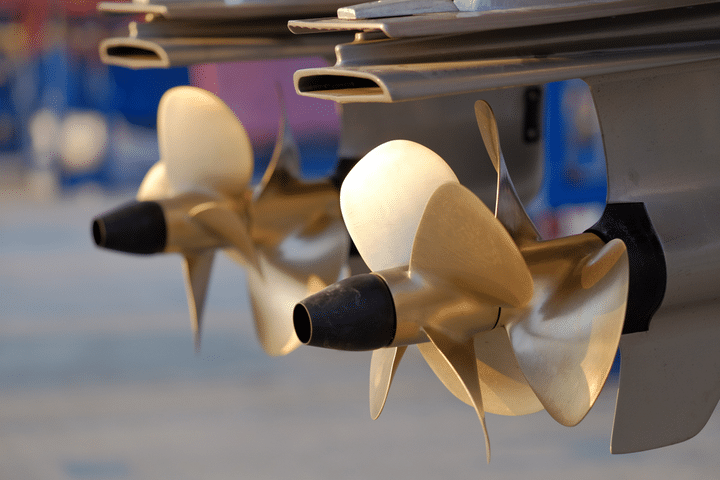
The choice between a three-blade and four-blade propeller is fundamentally a choice about how the available engine power is converted into thrust. Three-blade propellers are widely used because they provide a strong balance between acceleration, efficiency, smoothness, and top-end speed. Four-blade designs add blade area and can provide stronger low-speed grip, improved acceleration, stern lift, and better ability to keep a heavily loaded boat on plane. Mercury describes three-blade propellers as the general-purpose balance between low drag and smooth operation, while its four-blade designs are developed for applications where additional blade area and holding power are beneficial.
Neither design is universally better. The correct choice depends on the boat, engine, gear ratio, propeller diameter and pitch, hull design, operating load, desired RPM, and intended use. Yamaha’s official accessory range includes both three- and four-blade propellers and states that its propeller range is designed around different boat types and intended uses. Suzuki’s official parts catalogue likewise includes both three- and four-blade configurations for selected outboards, demonstrating that blade count is an application-specific engineering choice rather than a simple upgrade path.
How Blade Count Changes Propeller Behaviour
Adding a fourth blade increases the total blade area interacting with the water. That additional area can improve the propeller’s ability to maintain grip and generate thrust, particularly when the boat is heavily loaded or operating at lower speeds. Mercury specifically identifies improved hole-shot acceleration and stern lift as advantages of four-blade designs, while noting that the additional blade also introduces more drag.
A three-blade propeller generally has less blade area and can therefore offer lower drag and strong top-end performance when correctly matched. Mercury describes its three-blade designs as providing the best general balance between smooth operation and minimal drag. The difference is therefore not simply three blades versus four; it is a trade-off between blade area, grip, drag, acceleration, and the requirements of the complete propulsion system.
Three-Blade Propellers
Three-blade propellers are the conventional choice for a broad range of recreational and performance applications. Their relatively low drag and balanced blade arrangement can provide strong acceleration while preserving top-end speed when the propeller is correctly matched to the boat and engine.
Mercury identifies three-blade designs as its most popular general-boating configuration and explains that engineers can alter blade area, rake, and cup to tailor a three-blade propeller to specific applications. This means two three-blade propellers with identical nominal pitch can still produce different results because their blade geometry is different.
Four-Blade Propellers
Four-blade propellers are particularly useful where acceleration, grip, stern lift, and load carrying are important. The additional blade area can help a heavily loaded boat climb onto plane more effectively and remain on plane at lower speeds.
Mercury’s Fury 4, for example, is specifically designed for heavily loaded tournament bass boats and is engineered around speed, acceleration, and handling. Mercury states that its additional lift can allow the four-blade design to outperform the corresponding three-blade Fury on a heavily loaded boat carrying substantial fuel, batteries, and livewell water. This illustrates an important point: a four-blade propeller can sometimes deliver better overall performance even when its theoretical top-speed advantage is not obvious.
Acceleration and Hole Shot
If rapid acceleration from rest is a major priority, a four-blade propeller can provide a significant advantage in the appropriate application. The increased blade area can produce stronger initial thrust and help the hull transition onto plane more quickly.
Mercury’s Trophy Sport is an example of a four-blade propeller designed specifically around fast planing and holding power for flats and bay boats. Its manufacturer describes the additional grip as beneficial when getting onto plane quickly and maintaining control in shallow or choppy conditions.
A three-blade propeller can also provide excellent acceleration when properly matched. The important distinction is that the four-blade configuration gives manufacturers additional blade area to work with, which can become particularly useful when the boat is heavily loaded or the application demands greater low-speed thrust.
Top Speed
Three-blade propellers will often have an advantage when maximum top speed is the primary objective because they generally produce less drag than an equivalent four-blade design. Mercury’s technical documentation states that three-blade propellers generally provide higher top speed, while four-blade designs commonly offer faster planing and stronger cruising performance.
However, this should not be interpreted as an absolute rule. Propeller geometry, pitch, diameter, rake, cup, engine RPM, hull design, and loading can all change the result. Mercury’s Fury 4 is an example where a four-blade propeller can outperform a three-blade counterpart under heavy-load conditions.
Cruising Efficiency
Four-blade propellers can be advantageous when a boat spends substantial time at cruising speed, particularly when additional blade area allows the vessel to remain efficiently on plane at lower speeds. Mercury’s published comparison identifies four-blade propellers as generally more efficient at cruising speeds despite their additional drag.
But fuel efficiency should never be judged by blade count alone. A correctly pitched three-blade propeller on one boat can be more economical than a poorly matched four-blade propeller. The engine must still reach its manufacturer-specified operating range, and hull condition, weight, trim, speed, and operating conditions remain major contributors to fuel consumption.
Handling and Propeller Grip
Four-blade designs can provide additional grip in conditions where maintaining consistent propeller engagement is important. Mercury’s Revolution 4, for example, is designed to provide stern lift and maintain grip on larger centre-console applications, including situations where the propeller approaches the surface in rough offshore conditions.
This additional grip can translate into improved handling, particularly when turning, accelerating, operating in rough water, or carrying substantial loads. A three-blade propeller can still provide excellent handling when properly selected, but the additional blade area of a four-blade design gives engineers another way to optimise the propulsion system for demanding conditions.
Engine RPM and Pitch Changes
Changing from a three-blade to a four-blade propeller is not simply a matter of replacing one propeller with another of identical pitch. Blade count, blade area, and geometry can alter the engine’s operating RPM. Mercury’s owner’s documentation states that moving from a three-blade to a four-blade propeller will generally reduce full-throttle RPM by approximately 50–100 RPM on the applicable engine.
The actual change varies by propeller design and application. After changing propellers, the engine should therefore be tested under appropriate conditions to confirm that it reaches the manufacturer’s specified wide-open-throttle RPM range. Never select a propeller that allows the engine to exceed its recommended maximum RPM.
Load-Carrying Applications
Heavy boats often benefit from additional blade area because the propulsion system must generate enough thrust to accelerate and maintain planing performance under greater displacement. Fuel, passengers, batteries, livewells, fishing equipment, coolers, and other equipment can substantially alter the boat’s operating weight.
Mercury’s Fury 4 was specifically engineered around heavily loaded bass boats, while its Revolution 4 is intended for larger centre-console applications where strong stern lift and holding power are valuable. This makes four-blade designs particularly relevant to boats that routinely operate near their normal maximum load.
Watersports Applications
Watersports place a high demand on low-speed thrust and acceleration because the boat needs to bring additional resistance onto plane quickly. A four-blade propeller can be advantageous where strong hole shot and consistent grip are more important than absolute top speed.
Yamaha has specifically described its four-blade propeller designs as suitable for applications requiring improved acceleration and performance in rougher conditions, including waterskiing. The correct pitch remains critical, however, because adding blade area without appropriately matching pitch can move engine RPM outside the desired operating range.
Stainless Steel vs Aluminium Still Matters
Blade count is only one part of propeller selection. Material also influences the final result. Aluminium propellers are widely used for general-purpose applications because they are practical and economical, while stainless steel allows manufacturers to produce more rigid and refined blade designs.
Mercury states that stainless steel propellers can provide performance gains in acceleration and top-end speed because of their design efficiencies and greater durability, while aluminium remains suitable for general-purpose applications. Consequently, comparing three-blade and four-blade designs without considering material can produce an incomplete assessment.
Three Blades or Four Blades?
Choose a three-blade propeller when your priority is generally balanced performance, low drag, strong top-end speed, and broad recreational use. Choose a four-blade propeller when acceleration, low-speed grip, stern lift, load carrying, cruising performance, or maintaining plane at lower speeds are more important.
But the final selection must always be based on the complete propulsion system. Mercury, Yamaha, and Suzuki all provide application-specific propeller options rather than treating blade count as a universal performance hierarchy.
The best propeller is therefore not necessarily the one with more blades. It is the one that allows the engine to operate within its specified RPM range while producing the combination of speed, acceleration, efficiency, handling, and load-carrying ability required by the boat.