
The distinction between two-stroke and four-stroke outboards comes down primarily to how each engine completes its combustion cycle. A two-stroke engine completes the cycle in two piston strokes, producing a power event every crankshaft revolution, while a four-stroke engine completes its cycle over four piston strokes, with combustion occurring every two crankshaft revolutions. This fundamental difference affects engine construction, weight, power delivery, lubrication, fuel consumption, emissions, and maintenance requirements. Yamaha identifies the traditional advantages of two-stroke outboards as their relatively simple construction, low weight, strong power delivery, and straightforward maintenance.
Four-stroke outboards use a more complex valve system but provide characteristics that have made them dominant in modern recreational outboard ranges, particularly strong fuel economy, smooth power delivery, quieter operation, and lower exhaust emissions. Yamaha notes that it transitioned its recreational-use outboard lineup to all four-stroke models after four-stroke technology had advanced sufficiently to overcome many of the traditional advantages of two-stroke engines. The choice, however, should not be reduced to a simple “old versus new” comparison: the appropriate technology depends on the boat, application, available models in the relevant market, operating requirements, and manufacturer specifications.
Two-Stroke Outboards: Where They Still Make Sense
Traditional two-stroke outboards are valued for their comparatively simple mechanical architecture, low weight, compact dimensions, and responsive power characteristics. Their simpler construction can make certain maintenance and mechanical repairs more straightforward, while their power-to-weight characteristics remain attractive for applications where reducing engine weight is particularly important. Yamaha continues to offer two-stroke outboards in selected markets and applications, including models designed for commercial use and demanding operating environments.
Two-stroke technology is not, however, a single specification. Older carbureted engines, direct-injection two-strokes, and different lubrication systems can have substantially different operating characteristics. Yamaha’s historical HPDI technology demonstrated how direct fuel injection could improve the efficiency and emissions performance of a two-stroke design while retaining its compactness and power characteristics. Therefore, buyers considering a two-stroke should evaluate the specific engine technology and model, rather than assuming every two-stroke outboard performs the same way.
Four-Stroke Outboards: Why They Dominate Modern Recreational Use
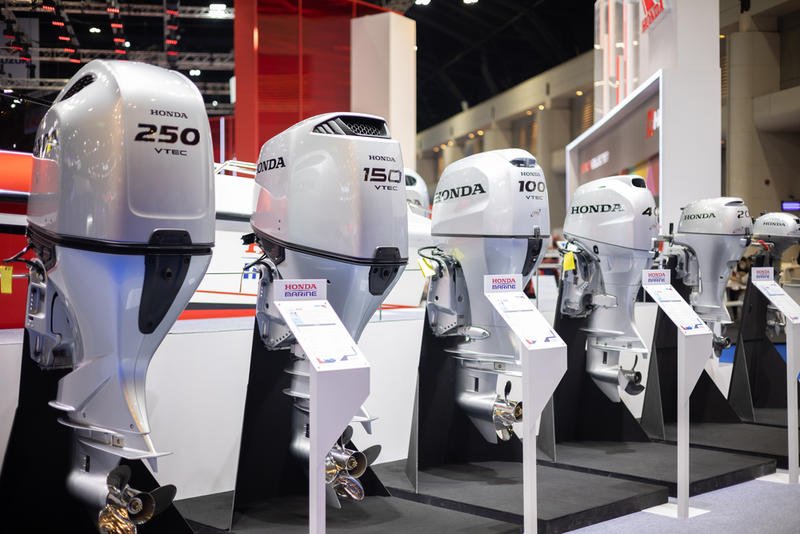
Four-stroke outboards separate the intake, compression, combustion, and exhaust processes across four piston strokes and use dedicated intake and exhaust valves. This architecture supports controlled combustion and contributes to the characteristics associated with modern four-stroke propulsion, including smooth power delivery, fuel efficiency, and reduced exhaust emissions. Yamaha states that its recreational-use outboard lineup moved to an all-four-stroke configuration as the technology developed, while Mercury currently offers a broad FourStroke range covering recreational applications.
Modern four-stroke outboards are also considerably more sophisticated than the early four-stroke designs that originally competed with two-strokes. Electronic fuel injection, digital engine management, advanced corrosion protection, electronic controls, and integrated diagnostic systems have become important elements of contemporary outboard technology. Mercury, for example, highlights fuel efficiency, corrosion protection, smooth operation, and compatibility with advanced electronic control features across its FourStroke range.
Weight and Power-to-Weight Considerations
Weight can be one of the most significant differences when comparing equivalent two-stroke and four-stroke outboards, although the actual difference depends entirely on the specific models being compared. Historically, the simpler architecture of two-stroke engines allowed manufacturers to achieve very low weight relative to their output. Yamaha specifically identifies lightweight and compact construction as core advantages of its two-stroke technology.
Modern four-stroke engineering has narrowed this gap considerably in many horsepower classes. Manufacturers use lightweight materials, compact powerhead designs, and purpose-built marine engineering to reduce mass while retaining durability. Mercury, for example, describes its current FourStroke designs as compact and suitable for a range of transom configurations. For a repower or smaller vessel, the actual published weight of the candidate engines should therefore be compared rather than relying on the general assumption that every two-stroke is lighter.
Fuel Economy and Operating Costs
Fuel consumption depends on considerably more than the two-stroke or four-stroke label. Engine design, displacement, load, propeller selection, hull efficiency, throttle position, operating speed, and sea conditions all affect actual consumption. Nevertheless, four-stroke architecture has inherent efficiency advantages because lubrication and combustion are handled differently, and modern electronic fuel injection and engine management further optimise fuel delivery.
Yamaha specifically identifies fuel economy as an inherent advantage of four-stroke engines, while Mercury highlights efficiency as a core characteristic of its current FourStroke range. For an owner covering substantial distances or operating frequently, fuel consumption can have a significant effect on total ownership cost. The most meaningful comparison should therefore use the actual engines under consideration and evaluate expected consumption at the vessel’s normal cruising load and speed.
Maintenance and Mechanical Complexity
Two-stroke engines generally have fewer internal moving components because they do not require the conventional intake and exhaust valve train used by four-stroke engines. Yamaha specifically notes the simpler structure and easier combustion-chamber maintenance associated with its two-stroke designs. That mechanical simplicity can be particularly valuable in applications where straightforward servicing and field maintainability are important.
Four-stroke engines contain additional components associated with their valve train and lubrication architecture, which means their maintenance requirements differ rather than simply being “higher” or “lower.” Oil and filter servicing are part of normal four-stroke ownership, while two-stroke engines have their own lubrication requirements depending on the specific design. In both cases, the manufacturer’s maintenance schedule should determine servicing intervals and procedures rather than assumptions based solely on engine type.
Noise, Smoothness and Riding Comfort
Four-stroke outboards are generally associated with smoother and quieter operation because of their combustion characteristics and engine architecture. Mercury specifically highlights balanced powerheads and vibration-dampening designs in its current FourStroke range. This can make a noticeable difference on family boats, cruising vessels, and applications where passengers spend extended periods underway.
Two-stroke engines can provide a more immediate and distinctive power response, particularly within their effective operating range. Yamaha describes the potential for strong acceleration and power delivery as a characteristic advantage of two-stroke technology. The practical difference depends heavily on the individual engine, propeller, hull, and calibration, so a direct model-to-model comparison is more meaningful than relying on engine-cycle characteristics alone.
Emissions and Environmental Considerations
Environmental performance is one of the major reasons modern recreational outboard development has moved toward four-stroke and advanced direct-injection technologies. Conventional two-stroke combustion can result in greater fuel and lubricant emissions than modern four-stroke systems, although direct-injection two-stroke technology was developed specifically to improve combustion efficiency and emissions performance. Yamaha’s HPDI development illustrates this evolution within two-stroke marine technology.
Four-stroke engines have become the dominant technology in many recreational markets partly because of their combination of fuel efficiency and emissions performance. However, environmental compliance is ultimately determined by the specific engine, certification, market, and applicable regulations, not simply whether an engine is labelled two-stroke or four-stroke. This is particularly important when purchasing older engines or importing equipment between different regulatory markets.
Which Is Better for Your Boat?
There is no universal answer. A modern four-stroke is generally the logical choice for many recreational buyers who prioritise fuel economy, smoothness, low emissions, refined operation, and broad manufacturer support. For certain commercial, remote, lightweight, or region-specific applications, a proven two-stroke may remain an appropriate choice where its weight, simplicity, power characteristics, or local serviceability provide genuine operational advantages. Yamaha’s continued availability of two-stroke products for selected global markets demonstrates that the technology remains relevant for specific applications.
The correct decision should therefore be based on the specific boat and specific engine models, not the engine cycle alone. Compare horsepower, engine weight, shaft length, fuel system, controls, propeller requirements, maintenance schedule, emissions certification, warranty, parts availability, and intended operating environment. For a new purchase or repower, manufacturer specifications should be checked carefully before selecting either technology.
Ultimately, the specific engine matters more than the label. A well-engineered, properly matched outboard operated and maintained according to its manufacturer’s requirements can provide reliable service in the application for which it was designed. Buyers should compare current specifications, certification, support, and operating costs for the exact models under consideration rather than making a decision based solely on two-stroke or four-stroke terminology.